Alcuin Quotes
Banish afar the foul worship of idols. On their alters let the blood of animals smoke no more, nor the soothsayer look for omens in warm entrails, nor the meaningless augur attend to the song of birds. Let all the images of the gods be smashed to the ground.
Flaccus
Paulinus, ?-644, English Roman Catholic Bishop of York, Instructions to Edwin, King of Pagan North Umbria, Quoted in Alcuin of York, ~780, , did at the beginning of the 21st century—over 1200 years later.]
Sourced by: Eigen's Political and Historical Quotations


These suras are ones that for some fundamentalist extremists justified the killing of Iraqis Muslims who worked with the British, Americans or other Coalition forces in the Iraq war or even politicians who cooperated with the coalition.


The Irish monks were loyal to the pope and were outraged when he was displaced by King Henry VIII. They were seen as a hotbed of disloyalty and therefore ordered to close. This is one of the many examples where an established government church dictated not only how people should worship but also prohibit other religions from functioning. These examples were well known to the American Founding Fathers and much of educated American opinion which was one of the drivers of the First Amendment and the separation of church and state.


Christian Neophytes were Indians who claimed that they had converted to Christianity. The French initially banned giving or selling firearms to the Indians of North America. However in 1640, they made an exception to provide arms to the Huron Indians who they thought had converted to Christianity. Four years later the Jesuits were using guns as the major motivation for conversion of Indians. The hypocrisy of using weapons of war to attract converts to a religion of peace gave way to the incredible success that the trading of guns for souls had achieved. The French military also thought that the armed Indians could be used as allies in the coming battle with England for control of North America. The English then armed their Indian allies, and the French and Indian Wars saw armed Indians on both sides.


Allen observed that atheists and irreligious people rarely believe in witchcraft. Even in free America, Allen had a very difficult time getting this work printed because it was so controversial culturally.


Luther’s attitude toward the Catholic mass was the main reason the Protestant churches abolished the mass.
motivates him as opposed to a plot He had entered the Catholic cathedral in Lisbon, and in the middle of the mass, wrested the host away from the bishop and trampled it on the ground. The Catholics thought that the Protestant English were about to launch a plot to establish a reformed church in Portugal. They arrested all Englishmen in Portugal. Finally, after much torture, the decision was reached that Gardener acted on his own, and he was roasted alive.

This article was originally directed against non-Muslim religions who actively sought to convert Muslims. However, Islamic organizations, have also historically made their greatest inroads with the poor and ignorant members of a society. The madrassas of Pakistan, the activities of Hezbollah, in Lebanon, and Hamas in Gaza all have common characteristics with the Salvation Army where services are provided for the poor and often uneducated with the required participation in religious services, education and/or prayer. There are many Christian, Muslim, and other religious leaders who do not approve of such attempts at conversion, but there are forces within these same religions who not only take advantage of poverty and ignorance to convert but are almost exclusively devoted to that tactic. The Russian Orthodox Church had the same protest against Protestant sects targeting the poor after the fall of the Soviet Union. In general, most religions see nothing wrong with converting people in times of crisis, so long as they are doing the converting. But if another religion is converting their adherents, then it is a violation of human rights.
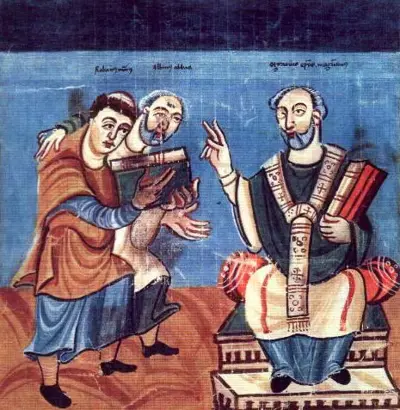
Alcuin of York – also called Ealhwine, Alhwin, or Alchoin – was an English scholar, clergyman, poet, and teacher from York, Northumbria. He was born around 735 and became the student of Archbishop Ecgbert at York. At the invitation of Charlemagne, he became a leading scholar and teacher at the Carolingian court, where he remained a figure in the 780s and 790s. "The most learned man anywhere to be found", according to Einhard's Life of Charlemagne (c. 817–833), he is considered among the most important intellectual architects of the Carolingian Renaissance. Among his pupils were many of the dominant intellectuals of the Carolingian era.
