James Monroe Quotes
Other interests of high importance will claim attention, among which the improvement of our country by roads and canals, proceeding always with a constitutional sanction, holds a distinguished place. By thus facilitating the intercourse between the States we shall add much to the convenience and comfort of our fellow-citizens, much to the ornament of the country, and, what is of greater importance, we shall shorten distances, and, by making each part more accessible to and dependent on the other, we shall bind the Union more closely together.
James Monroe, 1758-1831, 5th President of the United States (Democratic Republican, VA), First Inaugural Address, March 4, 1817
Sourced by: Eigen's Political and Historical Quotations

Although Madison vetoed the Federal bill to improve the national infrastructure, he was very much for the improvements and he said so in this veto message. He, however, did not see the Constitutional authority for the Federal government to appropriate moneys to be spent in the States for infrastructure improvement. He was for a Constitutional Amendment to do so or to make the improvements using State money as New York did building the Erie Canal. Alexander Hamilton, and many of the Congressmen who voted for the bill disagreed (many of whom were also in the Constitutional Convention) and did not see the Constitutional limitation that Madison did. See Hamilton’s Quote 644278. He was particularly concerned that small and less affluent states could not possibly have the skill to design these or the finances to build them. Later President’s and Congresses sided with Hamilton. It would be hard to envision America today of Madison’s view had prevailed.

At the time, roads were built by the states. This was one of the first instances urging that the Federal Government take some responsibility for roads. This would culminate when President Eisenhower proposed and created the National Highway System and as Madison predicted, it would have a massive economic benefit for the nation.

Building of roads and highways was not then an accepted national priority.


Monroe and many other politicians of the time believed that the constitution had not given the federal government the power to develop a road and canal system. He asked for a constitutional amendment providing that power.


Arguing that Slavery inhibited a society from development ...


Marie Joseph Paul Yves Roch Gilbert du Motier

FDR had envisioned a national highway system. He had taken a map of the United States and drew three horizontal lines across the country and another three vertical lines running North to South. These he envisioned as a national highway system. The Second World War intervened with all men and material devoted to the war effort, highway ideas were all on the back burner. After the war President Dwight Eisenhower, in one of the great presidential achievements of American history, initiated the Federal National Highway System. The main difference was a reversal of the classic party positions. Democrat Roosevelt had planned to have the users pay for much or part of the construction and maintenance, while Republican Eisenhower accepted the entire burden on the general taxpayers and tolls and usage fees were banned on Federal Highways.

This section of the message was all about the Erie Canal that was under construction. Note that unlike today, where interest in public works and development is so localized, Clinton was extolling the virtue of developing the economy of the region and the nation. The money was all New York State money. The Federal Government would not fund the Erie Canal as they did not believe it was technically feasible to construct. See {624484} . Patriotism had a different meaning then.
It was on time and on budget. It is hard to imagine that we could complete a project this large today. It would take more than 8 years to do the studies and get the permits and fight off the lawsuits. However, the engineering feat for the up and coming young country was as Clinton said, “unparalleled in the experience of mankind.” America had already exceeded the Ancient Egyptians, the Europeans, the Chinese. The economic development for the young nation was enormous—as big as the digital revolution almost two centuries later.


James Madison agreed on the importance of infrastructure but disagreed that the Congress had to Constitutional authority to spend federal money for an improvement in a state. See Quote 644277.


This Act formed the basis of the Canadian Constitution. Transportation policy was important to the Canadian government just as in the United States.

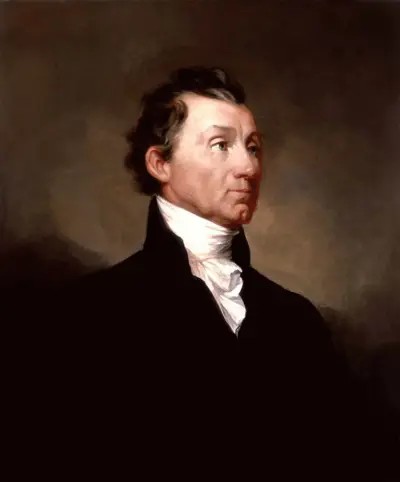
James Monroe was an American statesman, lawyer, diplomat and Founding Father who served as the fifth president of the United States from 1817 to 1825. A member of the Democratic-Republican Party, Monroe was the last president of the Virginia dynasty; his presidency coincided with the Era of Good Feelings. He is perhaps best known for issuing the Monroe Doctrine, a policy of opposing European colonialism in the Americas. He also served as the governor of Virginia, a member of the United States Senate, the U.S. ambassador to France and Britain, the seventh Secretary of State, and the eighth Secretary of War.
