Lee Kuan Yew Quotes
Of course there are Chinese millionaires in big cars and big houses. Is it the answer to make a few Malay millionaires with big cars and big houses? …. Meanwhile, whenever there is a failure of economic, social and educational policies, you come back and say, oh, these wicked Chinese, Indian and others opposing Malay rights. They don't oppose Malay rights. They, the Malay, have the right as Malaysian citizens to go up to the level of training and education that the more competitive societies, the non-Malay society, has produced. That is what must be done, isn't it? Not to feed them with this obscurantist doctrine that all they have got to do is to get Malay rights for the few special Malays and their problem has been resolved.
In Indonesia, Singapore and Malaysia and much of Asia, there is a Chinese and Indian minority that is typically more affluent than the majority Malays. These governments have tried various affirmative action programs including forcing their citizens of Chinese extraction to give up at least half their control of businesses to Malays. Ethnic pogroms break out every few years where non Malays, and non Muslims are beaten and many killed. Yet essentially there has been no significant change in the ownership of businesses by ethnicity.
Lee Kuan Yew, Prime Minister of Singapore, Speech to the Parliament of Malaysia, 1965
Sourced by: Eigen's Political and Historical Quotations

He was very conservative in almost all things, but here and with poverty (see {638805}) he was far ahead of his time.


The traditional Hindu social structure established castes – levels of society with Brahmins at the top and untouchables at the bottom. When India gained independence, the caste system was made illegal. Nonetheless, it is still followed by hundreds of millions of Indians. Religiously the Buddhists and the Hindus have had different philosophies. Ilaiah is a Buddhist who opposes the traditional Brahmin social structure and is a supporter of “Dalitization” – a change in the Indian culture to make the Dalits (untouchables) equal de juro and de facto.


Worry about the disproportional power of the rich is not a modern concern, but was a concern from the very beginning of the nation. There was a belief that if there were a legislative body representing the entire population the rich would tend to dominate it. The solution that England had found was a bicameral Parliament—a House of Lords representing the wealthy and the powerful and the House of Commons, representing the bulk of the people. America followed suit but never did have the class distinction of England.


It was not until this publication that people who suggested that discrimination and lack of education and opportunity might have something to do with the problem Blacks faced in society were regarded by many Americans as anything but left wing intellectuals.


He was writing about America and many of the industrial democracies who at the time, as a result of globalziation, technology, government action and inaction, and other factors, had gone through a 30 year period of increasing disparities.


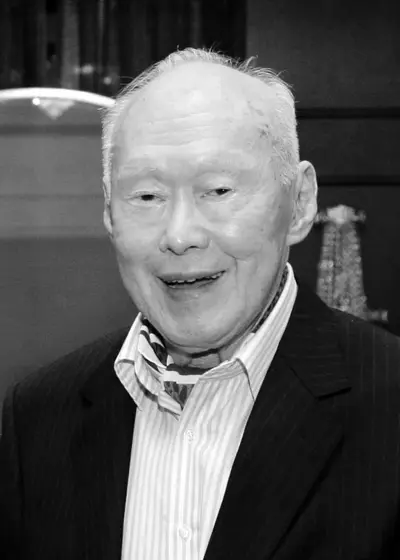
Lee Kuan Yew GCMG CH SPMJ, often referred to by his initials LKY, was a Singaporean statesman and lawyer who served as Prime Minister of Singapore from 1959 to 1990. As one of the founding members of the People's Action Party, Lee is recognised as the nation's founding father, credited with rapidly transitioning the country from a "developing third world country into a developed first world country within a single generation" under his leadership. Lee died of pneumonia on 23 March 2015, aged 91. In a week of national mourning, about 1.7 million Singaporean residents as well as world leaders paid tribute to him at his lying-in-state at Singapore's Parliament House and at community tribute sites around the country.
