J. William Fulbright Quotes
Now, you know that's nonsense. How many Communists do you know at the Courthouse? Or among your teachers? Or preachers? .... Internal Communism is a very minor problem with us, and one I think the FBI can handle quite well.
Reacting to accusations that he was soft on communism:
J. William Fulbright, 1905-1995, U. S. Senator (Democrat, AR), Chairman, Senate Foreign Relations Committee, Campaign speech, 1962
Sourced by: Eigen's Political and Historical Quotations


The Red Scare had already reached most conservatives and Truman and most others had not yet been affected by the fear of Communism that so many people had through the 1970s.

For years the Nationalist Military under Chiang Kai-shek and other Generals like Ma Hongkui had murdered suspected communist politicians, and in the Civil War with the communists rarely took any prisoners. The Communists in turn, “tried” and executed landlords and other major capitalists who had previously in their view treated the peasants badly and were responsible for much starvation. Neither side had any scruples about ignoring human rights and committing war crimes.

This is a classic example of one of the many politicians of the 20th and 21st century who would call anyone a communist who opposed anything that he regarded as American. In actuality, there were some very conservative economists and shareholders who did not think that the funding of celebrations had little or no value for shareholders. Many on the left were concerned that the celebration was in great part paid for by all Americans because of the tax deduction that was allowed. However none were communists.


This quotation appears to be the origin of the ultra-right wing conspiracy theory that a communist will become President of the United States without the public ever knowing that he was a Communist. During the Obama administration, there were a number of ultra-rightists who believed that Obama was the culmination of this plan which the communists began in the 1950s and was only "discovered" Fred Koch and the John Birchers in 1963.


In 1921 an Paul E. De Mott, an American Quaker famine relief worker in Germany was arrested as a "Bolshevik" and murdered without trial. American correspondents heard about the crime and asked for a statement from the chief American diplomat in Germany.

After this, no other member of the Executive branch went before McCarthy again


The Kuomintang nationalists under Chiang Kai-Shek tried to stay in power in China, but their corruption and incompetency at government lost them the support of most of the Chinese. The Chinese communists took over the government. The Nationalists then invaded the offshore island of Taiwan but claimed to be the rightful government of all of China. For many years they controlled the Chinese seat in the UN and they refused to recognize the fact that they had failed to gain the loyalty of the Chinese people.
Although the U. S. denied propaganda and dirty tricks efforts interfering in the internal affairs of South American Countries, this memo proves that there were some instances of just that.

He lists a number of employees including his own wife. The foundation was the L. Ron Hubbard Dianetic Research Foundation Inc. In this case a religious leader was asking the government for assistance in determining who was and was not fit to be a member and an associate of his organization. The FBI apparently ignored his accusations, and there was no government action though he continued to accuse associates throughout his life. The FBI agent who met with Hubbard to investigate his charges wrote “mental case” on the file.

Kennedy was not being literal, but was sarcastically joking about the overemphasis that J. Edgar Hoover and the FBI leadership was placing on investigating civil rights leaders and communists instead of investigating the hundreds of Southern murders and assaults on civil rights workers and organized crime. The FBI leadership was itself quite racist at the time, and Hoover never wanted to take on organized crime. He did not regard organized crime as an existential threat to the United States (the way he did about civil rights demonstrations) and he feared that with the big money available to organized crime, many of his agents would be corrupted.
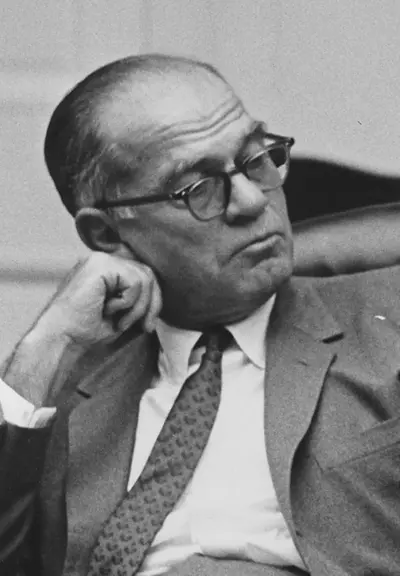
James William Fulbright was an American politician, academic, and statesman who represented Arkansas in the United States Senate from 1945 until his resignation in 1974. As of 2021, Fulbright is the longest serving chairman in the history of the United States Senate Committee on Foreign Relations. He is best known for his staunch multilateralist positions on international issues, opposition to American involvement in the Vietnam War, and the creation of the international fellowship program bearing his name, the Fulbright Program.
