H. G. Wells Quotes
Nothing could have been more obvious to the people of the early twentieth century than the rapidity with which war was becoming impossible. And as certainly they did not see it. They did not see it until the atomic bombs burst in their fumbling hands.
Wells, H. G. The World Set Free. Macmillan, 1914.


As the atomic bomb evolved to the hydrogen bomb and the test results were learned by political and military leaders, the perception of the danger became much greater, especially when the Russians and French also developed their nuclear weapons. After that, and Einstein’s predictions about the cost and quantity, leaders in the world all became conscious of the danger of Mutually Assured Destruction (MAD), most leaders realized that it was impossible see atomic weapons as anything but defense.


Sandia is a company that has gotten almost all their business from the Federal Government for doing research and development of nuclear weapons. Based on this view and others the AEC and the military not only developed small atomic bombs with short range rockets that could be transported in jeeps, but actually developed a 51 lb. atomic bomb that a soldier carried on his back. The idea was for these solders to parachute behind enemy lines, place the bomb near an important enemy facility and escape the critical zone on foot before the bomb exploded. It was never used in combat and receded in interest except for the fact that it proved it was possible for a terrorist suicide bomber on foot to place and explode a nuclear weapon.


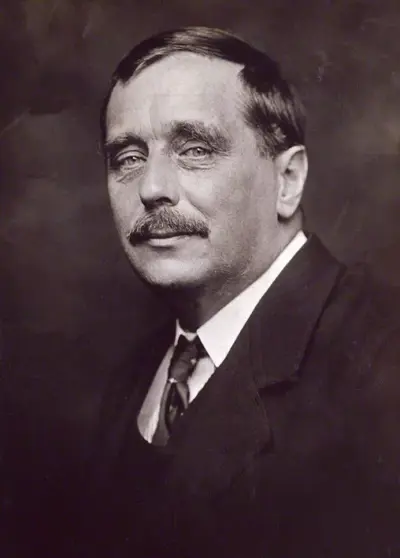
Herbert George Wells —known as H. G. Wells—was a prolific English writer in many genres, including the novel, history, politics, social commentary, and textbooks and rules for war games. Wells is now best remembered for his science fiction novels and is called a "father of science fiction", along with Jules Verne and Hugo Gernsback.[a] His most notable science fiction works include The Time Machine (1895), The Island of Doctor Moreau (1896), The Invisible Man (1897), and The War of the Worlds (1898). He was nominated for the Nobel Prize in Literature four times.
