Ismail Serageldin Quotes
Not every obnoxious talk leads to progress, but we cannot tell which unusual idea, which seditious thought will be tomorrow's accepted truth and enshrined right ... after all, all that we take for granted, was once deemed extremely objectionable... So, not knowing where the next big step in the progress of human civilization will come from, we open our ears, our minds and our hearts to the new, the unusual and the contrarian.
Islamic modernists like Serageldin are many among the educated Muslims but their views are often drowned out by the violence and extremist statements of the fundamentalists.
Ismail Serageldin, Egyptian Director of the Library of Alexandria & Historian, Member of the Egyptian Senate & World Bank Enviornmental VP & World Bank Enviornmental VP & World Bank Enviornmental VP, To Speak and To Hear: Two Sides of the Same Coin, 2009
Sourced by: Eigen's Political and Historical Quotations

Islamic modernists like Serageldin are many among the educated Muslims but their views are often drowned out by the violence and extremist statements of the fundamentalists.


In 2005 an Egyptian writer, Usama Anwar Ukasha, criticized one of the Prophet’s companion’s role for causing dissention and divisiveness in Islamic history. Some called for his legal punishment for slandering a holy figure (see {588714}) and a law case was brought to force him to divorce his wife—so that she would not be “contaminated by his heretical thoughts. Al-Bana argued for freedom of thought and speech on such subjects. His view was particularly important since he was the brother of Hassan Al-Bana, the founder of the Muslim Brotherhood, a powerful fundamentalist organization. Note that Al-Bana’s call for intellectual freedom does not go so far as to say that it should be legal to criticize The Prophet Muhammad and it illustrates how far even modern Islam has to go to meet reasonable standards of freedom of thought and speech.

Ibn al-Nafis was one of the great scientists of all time. He analyzed the human heart, lungs, and circulatory system. This quotation is often given by Muslim modernists and reformers to illustrate that Islam at one time was open to new knowledge, dissent, ideas of all kinds. A century later, Islam closed intellectually and later and even today, Muslims are killed for what became heresy. Truth became determined by the Koran and the words of The Prophet only, Christianity and the Church imposed a similar restrictive view of truth using the Bible and Jesus. However, the Reformation and modernity led Christianity to merge and adopt the more modern and scientific view with the exception of some Christian fundamentalists. Islam had the modern view and abandoned it causing the many educated Islamic reformers and modernists of today great difficulty in changing the culture and laws as a whole.


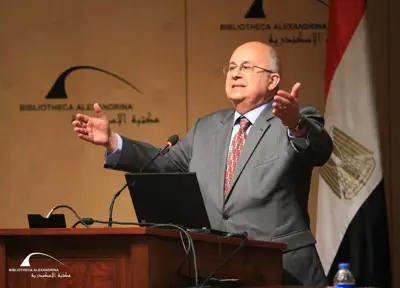
Ismail Serageldin (/ˈsɛrəɡɛldɪn/; born 1944 in Giza, Egypt), Founding Director of the Bibliotheca Alexandrina (BA), the new Library of Alexandria, inaugurated in 2002, is currently, Emeritus Librarian, and member of the Board of Trustees of the Library of Alexandria. He serves as Chair or Member of a number of advisory committees for academic, research, scientific and international institutions and civil society efforts, including as co-Chair of the Nizami Ganjavi International Center (NGIC), and serves on the Advisory Committee of the World Social Science Report for 2013 and 2016, as well as the UNESCO-supported World Water Scenarios (2013) and the executive council of the Encyclopedia of Life (2010) and Chairs the Executive Council of the World Digital Library (2010). He also co-chaired the African Union's high level panel for Biotechnology (2006) and again for Science, Technology and Innovation (STI) in 2012–2013, and was a member of the ICANN Panel for the review of the internet future (2013).
