A. P. Herbert Quotes
Nobody's wrong but England – and England's always wrong, Too late – or else too early – too soft – or else too strong. And when for once the wide world begins to praise her name Her own sons crowd and hurry to shout her back to shame.
Alan Patrick Herbert, 1890-1971, British Writer & Member of Parliament, "Poor Old Britain", Leave My Old Morale Alone
Sourced by: Eigen's Political and Historical Quotations


Expressing distress that the British were involved in one war after another in the Middle East that she thought never would have occurred if Britain had a foreign policy instead of "Muddling Through". Bell was responsible for setting most of the borders and geographical distributions of peoples in the Middle East, She did the best she could without any strong policy to guide her. A Century later, the Middle Eastern nations were still fighting over those borders, but they remained essentially intact.

This principle has been promoted by almost every party and government in every democracy—and even in totalitarian nations, that had an aggressive foreign policy that and had domestic critics. By eliminating internal debate of the foreign policy or war policy, the government accomplishes two objectives. Foreign enemies, rivals and even friends perceive that the nation is much more united on the policies than it really is, and the administration does not have to spend time and effort fending off critics or opponents domestically. The price, as every nation has discovered, is not only more intense and sometimes violent opposition when things do not go right or as promised, but the nation tends to maintain a failed policy too long and does not change and minimize its damages. The Vietnam War in America was a classic example of both of these prices being paid dearly.


The Gladstone government delayes and the force did not arrive on time. The town fell to the Madhi’s forces. Gordon was killed.

Although a member of the Prime Minister’s party and Cabinet, Cooper was so outraged that he called for Chamberlain’s resignation leading to Winston Churchill becoming Prime Minister.


He was commercially a very successful author, and as such was in a high tax bracket.


The FLQ was a Quebec revolutionary group seeking Quebec independence from Canada.
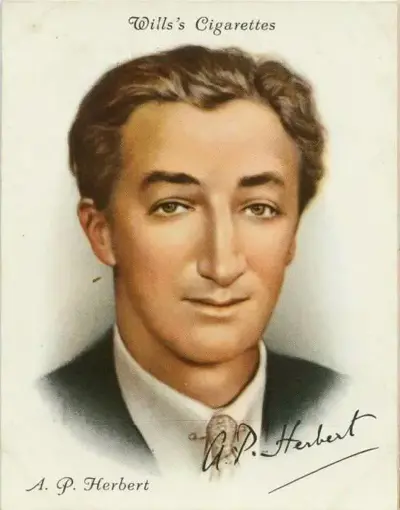
Sir Alan Patrick Herbert CH, usually known as A. P. Herbert or simply A. P. H., was an English humorist, novelist, playwright and law reform activist, and an Independent Member of Parliament for Oxford University from 1935 until 1950, when university constituencies were abolished. Born in Ashtead, Surrey, Herbert attended Winchester College and New College, Oxford, graduating with a starred first in Jurisprudence in 1914. He joined the Royal Naval Volunteer Reserve as an ordinary seaman in World War I, later serving as an officer with the Royal Naval Division. He fought in Gallipoli and on the Western Front, becoming battalion adjutant in 1917, before injury excluded him from the front line. After the war, he published The Secret Battle and joined the staff of Punch in 1924. He also wrote librettos for musicals. Elected as Independent MP for Oxford University in the 1935 general election, Herbert campaigned for private member's rights, piloted the Matrimonial Causes Act 1937 through Parliament, opposed the Entertainments Duty, and campaigned against the Oxford Group. He joined the River Emergency Service in 1938 and served in World War II as a petty officer in the Royal Naval Auxiliary Patrol. He captained his river boat, the Water Gipsy, on the River Thames. In 1943, he joined a parliamentary commission to investigate the future of the Dominion of Newfoundland.
