Swami Vivekananda Quotes
No religion on earth preaches the dignity of humanity in such a lofty strain as Hinduism, and no religion on earth treads upon the necks of the poor and the low in such a fashion as Hinduism.
Swami Vivekananda, 1863–1902, Narendra Nath Datta, Indian Hindu Monk & Teacher, Speech, World Parliament of Religions, 1893, Volume 5, Epistles
Sourced by: Eigen's Political and Historical Quotations

The traditional Hindu social structure established castes – levels of society with Brahmins at the top and untouchables at the bottom. When India gained independence, the caste system was made illegal. Nonetheless, it is still followed by hundreds of millions of Indians. Religiously the Buddhists and the Hindus have had different philosophies. Ilaiah is a Buddhist who opposes the traditional Brahmin social structure and is a supporter of “Dalitization” – a change in the Indian culture to make the Dalits (untouchables) equal de juro and de facto.

Robertson does not mention the fact that Hindus are the majority of the world’s largest democracy—India. Freedom thrives there and political equality is extensive. However, economic equality is sadly lacking as in the Untied States. However, India is more unequal.


Paz was the Ambassador to India. The caste system in India was outlawed by the Indian Constitution, and the government has made many effort at affirmative action to eliminate it put as Paz observed it is so ingrained in Indian tradition, culture and religion that it continues to persist.
Paz was the Ambassador to India


This novel won the Booker Prize—one of the great achievements in literature.


Observation of the other fugitives in Canada
Head of the Sikh Religion. He was the first Sikh Guru to utilize weapons,

Jinnah himself preached non-violence. At the time there was vicious sectarian violence throughout India but especially in The Frontier Province. However, the Muslims of the day did not heed him or Nehru or Gandhi for that matter and the violence continued. Jinnah however was a particularly shrewd politician who successfully used the threat of Muslim violence to obtain a separate Islamic state with Indian independence. He pointed to the threatening resolution issued earlier {627153}. The man who publicly preached peace, privately threatened violence.

Although a Hindu, Nehru wrote of the atrophied Hindu society of India which enabled the Muslims to invade, conquer, and spread Islam over India.

He is often referred to as “of Lahore.” He was a much better theologian than a historian. His credit of Islam with the principles that would end slavery, ignored the fact that just as American founding fathers espoused equality and freedom yet some owned slaves, likewise Mohammed, the founder of Islam, was a slaveholder. Historically, long after most of the world had abolished slavery, it still existed in the Islamic nations. They were forced out of the African slave trade by the European powers in the 19th century. But slavery was legal in Saudi Arabia as late as the 1960s. Slavery was still practiced in Sudan in 2005 with Muslims attacking Christians and Animists and taking them as slaves despite the official laws banning such practices. The government itself aided the slavers. Also, although Islam is credited with a major assault on slavery, it was not slavery per se that Muhammad banned. It was the slavery of another Muslim. Sharia and the Koran allows slavery so long as the slave is an unbeliever.

Arguments against the Partition of India at the time centered around the poor economic viability of a separate Muslim state. However Iqbal and others placed the cultural issues in the forefront. They eventually prevailed.
Pandita Indrani Rampersad. She is the first Hindu woman who ever became a pundit—a religious expert who guides Hindus. She is also a professor in the United States.

At the time, Ambani was the richest man in India. Almost all of the great business developers have objectives far more than making money.


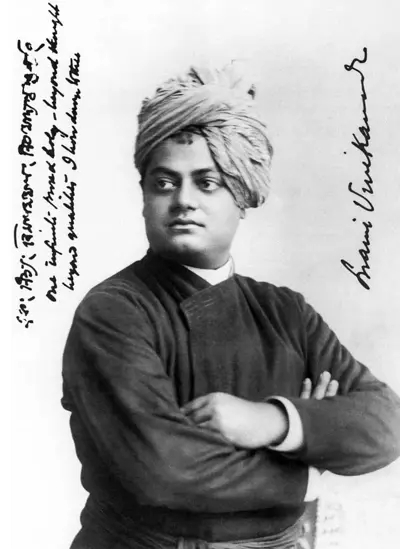
Swami Vivekananda, born Narendranath Datta (Bengali: [nɔrendronatʰ dɔto]), was an Indian Hindu monk. He was a chief disciple of the 19th-century Indian mystic Ramakrishna. He was a key figure in the introduction of the Indian philosophies of Vedanta and Yoga to the Western world, and is credited with raising interfaith awareness, bringing Hinduism to the status of a major world religion during the late 19th century. He was a major force in the contemporary Hindu reform movements in India, and contributed to the concept of nationalism in colonial India. Vivekananda founded the Ramakrishna Math and the Ramakrishna Mission. He is perhaps best known for his speech which began with the words "Sisters and brothers of America ...," in which he introduced Hinduism at the Parliament of the World's Religions in Chicago in 1893.
