Louis D. Brandeis Quotes
No regulation can be enforced which is not reasonable.... Unenforceable or harassing laws tend to make criminals.
Louis D. Brandeis, 1856-1941, U. S. Supreme Court Justice, Quoted in Mason, Brandeis: A Free Man's Life, Viking, 1946
Sourced by: Eigen's Political and Historical Quotations


The article he wrote was the first serious plan and proposal to repeal Prohibition which was opposed by most people after the country had experienced the negative unintended consequents of making alcohol illegal. This was not unlike the second thoughts that many Americans began to develop regarding the War on Drugs at the end of the 20th century. Many felt the good that prohibition did (it improved the nation’s healt) was not worth the bad that came with it (crime, corruption, police brutality, disrespect for the law.)


Speaking in the Senate about the Omnibus Crime Bill under consideration:

This ancient observation was rephrased most forcefully by Andrew Jackson in his 1832 attack on Chief Justice John Marshall.


CREEP in the Nixon Campaign. He was himself a convicted Watergate conspirator


Mulcts were fines. This was the then common view of educated people regarding the criminal justice system and what we would consider today as barbarous punishments. Note the view that those who had money should pay fines for some crimes but those without money should have their bodies mutilated for the same crimes.


This interesting historical quotation illustrates the fact that in almost every American generation there are those who believe that society has gone too far in protecting the rights of criminal suspects at the expense of law and order in the general society. This is nothing new. This is a classic argument given by those who would deny a defendant the Constitutional protection against self-incrimination. The belief that an innocent man has nothing to fear from the police is refuted by the many cases of innocent men being convicted by evidence they have given in the belief that they were innocent, and served long jail sentences only to later be proved by DNA evidence that they could not possibly have been guilty. Since Nott’s day, society has not only found many cases where honest error was made by the police or prosecutors, but many where there was venal prosecutorial misconduct and defendants were jailed even though the authorities were aware of evidence of innocence and kept it secret. There have been a number of these cases where a defendant was on death row and about to be executed when it was found he was innocent. Probably there have been men wrongly executed. See {629444} for a probable example.


As this quotation demonstrates, this problem has plagued America for a long time. In terms of crimes committed, for example, General Electric Corporation has committed more crimes than any other criminal enterprise, but it thrives despite this and the penalties are seen as just a slap on the wrist when they do get caught but they do not even get prosecuted for many of their crimes like most large corporations and rich individuals who commit crimes. The people who go to jail are usually the lower level or middle level criminals and the kingpins, the ones with the control and the money, rarely even get prosecuted. In the Great Recession, the largest banks in America committed tens of thousands of serious crimes by forging signatures and making false claims on legal documents. Not a single executive ever went to jail or was even given a suspended sentence. The banks paid small fines.


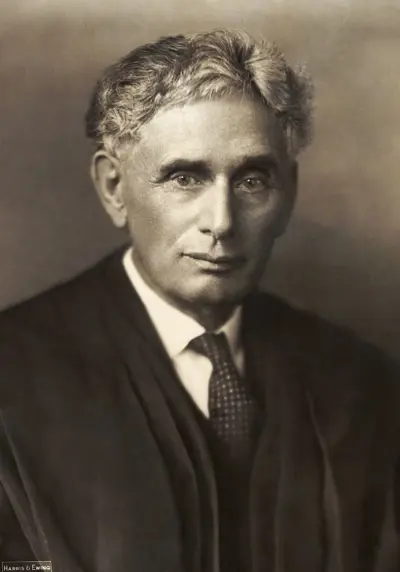
Louis Dembitz Brandeis was an American lawyer and associate justice on the Supreme Court of the United States from 1916 to 1939. He was born in Louisville, Kentucky, to Jewish immigrant parents from Bohemia (now in the Czech Republic), who raised him in a secular home. He attended Harvard Law School, graduating at the age of 20 with the highest grade point average in the law school's history. Brandeis settled in Boston, where he founded a law firm (that is still in practice today as Nutter McClennen & Fish) and became a recognized lawyer through his work on progressive social causes.
