Andrew J. Bacevich Quotes
No American witnessing the way that President George W. Bush and his generals have bungled the Iraq war can deny that our leaders, civilian and military alike, will have to get a lot smarter if the U.S. armed services are to persuade the Islamic world to embrace the blessings of democracy.
Andrew J. Bacevich, Political Scientist & Historian, Executive Director of the Foreign Policy Institute at the Paul H. Nitze School of Advanced International Studies, A Warhorse of a Different Color,” Wilson Quarterly, Spring 2007
Sourced by: Eigen's Political and Historical Quotations


Podharetz was citing the Vietnam war. The two American occasions where the plausibility seemed to fade were the Vietnam War and The Irag war. Both Presidents Lyndon Baines Johnson and George W. Bush as Bismarck predicted, had much political trouble over the wars.


Barry Goldwater in the 20th century used a variation of this quotation. See {601784}.


Kennen, one of the great American wise men for foreign affairs, could not have predicted the outcome of the Iraq war any better.

Ironically, Lieberman was using this quotation to campaign against Bush’s son, George W. Bush.

3 years later he led America on a huge invasion and nation building project in Iraq. It turned out that had he listened to his own advice and not flip-flopped, the huge cost of the Iraq War might have been avoided.

On military or foreign policy matters his view was that presidents ought not to rule anything in or out so that he/she can keep all the options open and not reduce future flexibility.
The attack on the World Trade Towers and our military reaction to that could not fairly be blamed on Bush. However, the Iraq War was certainly a policy choice he made. And he also made the decision to cut taxes (mostly for the rich) on the assumption that this would stimulate the economy and produce even more taxes. It did not. And also on Bush’s policy responsibility was his decision not to raise taxes to pay for a war. This had never been done in American history. And Bush was fighting two wars. In addition when he took office Bill Clinton had balanced the budget and left a substantial surplus. Instead of using the surplus to pay for his other policy decisions, he spent it.

This quotation is a good example of how tolerant some nations can be in terms of maintaining diplomatic relations and trade relations with other countries. The American and English governments chose to simply protest and condemn the slanderous statement but decided that the Prime Minister was pandering to his political local Islamic base, so took no further action and kept open diplomatic relations. Mahathir had a history of being very accusatory of the West with respect to anything that affected the Arab Muslims. The number of Muslims killed by the Americans and British in the Iraq War was very small compared to the huge number of Muslims killed by other Muslims in their Sunni Shiite civil war. While Bush and Blair both generated support for the Iraq invasion by making claims of WMD development in Iraq that were false, it is not clear whether or not they knew their statements were false, should have known that they were false, created an atmosphere against Iraq that was likely to produce false accusations, or were simple misled by poor intelligence. Mahathir, of course, chose to assume the worst case, and claim it was true, which is what many people think Bush and Blair did in analyzing the intelligence on Iraq.


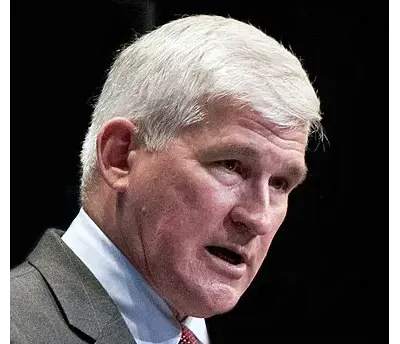
Andrew J. Bacevich Jr. is an American historian specializing in international relations, security studies, American foreign policy, and American diplomatic and military history. He is a Professor Emeritus of International Relations and History at the Boston University Frederick S. Pardee School of Global Studies. He is also a retired career officer in the Armor Branch of the United States Army, retiring with the rank of colonel. He is a former director of Boston University's Center for International Relations (from 1998 to 2005), now part of the Pardee School of Global Studies. Bacevich is the co-founder and president of the Quincy Institute for Responsible Statecraft.
