Kimmei Quotes
Never from former days until now have we had the opportunity of listening to so wonderful a doctrine.
This represents the period of introduction of Buddhism into Japan. It is as historically and religiously important as when Roman Emperor Constantine accepted Christianity. The Emperor was introduced to the new religion by way of Korean Buddhists. He wanted to make Buddhism the state religion, but many of his more traditional advisors were opposed. As a compromise Buddhism was allowed but not required. This was on a trial basis. There was however an outbreak of disease in the land and many claimed it was because people had abandoned the old Shinto ways. Since then many Japanese have become Buddhists and even in modern times there are some conservative traditionalists who want Shinto principles and the worship of the Emperor to be the only religion.
Kimmei, 509-571, Japanese Emperor, Statement when the doctrine of Buddhism were told to him
Sourced by: Eigen's Political and Historical Quotations


Carroll was writing to Troy during the time of the question of Catholic emancipation in England. Here he is clearly alluding to the British form of government. Carroll never missed the opportunity to champion religious freedom as manifested in the U.S. Constitution. For an earlier example of his praise for religious freedom, see {596933}.

In addition to being a Roman Catholic priest, Father Coughlin was an outspoken radio commentator who was well known for his controversial political opinions, see {598783}, {598784}.

Description of picketing protesters at one of his speeches.


This quotation is one of the great religious ecumenical statements of history. Mani’s religion became extinct. Zoroaster was the prophet who founded the religion of Persia that preceded Islam and still has some followers. Like Judaism and Christianity, it is allowed under Islam as Mohammad had a large part of the Middle East who followed that religion.

This view was infuriating to the Rabbis, Priests and Immams of the time. Miracles and Scrip[ture were not determinatve Spinoza taught but the issue was did the docrine of the religion make sense. Spinoza’s ideas were considered so radical and dangerous that he was the only man in history who was excommunicated by the Catholics, the Jews and the Muslims.


The major religions differ when it comes to conversion. Buddhism, Judaism, Hinduism, and some Christian Religions do not aggressively seek converts but will accept converts who come themselves. Other Christian religions and Islam aggressively try and convert others and see it as their religious duty to do so.
Buddhists believe in reincarnation and by donating money they are attempting to secure a higher (and avoid a lower) station for themselves in the next life.

This is a very important quotation. It is the first American expression of the “wall of separation” concept between church and state.


Jorge Mario Bergoglio. This quotation was reprinted in religious and secular organs of almost all religions as the message was universal and could apply also to non-Roman Catholic Churches and non-Christian religions. The Pope in this statement did not change church doctrine one bit. It urged a major change in tactics, context, emphasis and style. Extreme fundamentalists within the Roman Catholic church and without, however, saw the statement as a softening of the moral position of the church regarding these controversial areas. Most however welcomed his quotation as long overdue and a stylistic throwback to a different time where people were less educated and less informed by media.
He saw the different religions’ “messengers of God” such as the Jewish prophets, Jesus, and prophets of other religions as all part of God’s inspiration of man. His writings were influential on several religions. For example, Saint Thomas Aquinas quotes Mani on several occasions.
Most religions do not elevate happiness to a very high objective. Buddhism does however. Interestingly, the “pursuit of happiness” is a fundamental objective of American Democracy.

Also inscribed in gold around the Dome of the Rock. This was the most overt statement against Christianity and the Trinity in the Koran.


Jews were forced to convert to Catholicism under penalty of death. While the archbishop did not approve, he did not describe the murders in moral terms or used his great religious power to stop the practice.
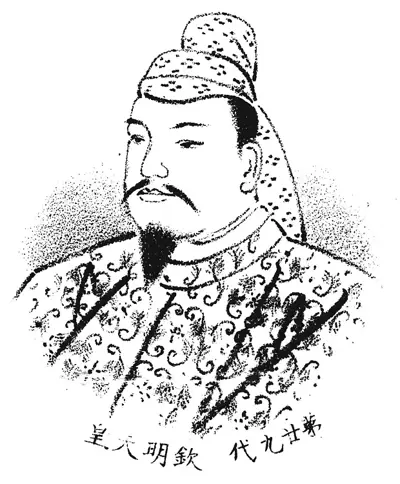
Emperor Kinmei (欽明天皇, Kinmei-tennō, 509–571) was the 29th Emperor of Japan, according to the traditional order of succession.
