Alan Watts Quotes
... nets, grids, and other types of calculus.
Watts, Alan. The Book: On the Taboo Against Knowing Who You Are. Pantheon Books, 1966.


This was one of the great scientific predictions of how science would develop.

3rd Earl Russell of Kingston. In mathematics the numbers can count people, autos, sins, molecules, or paintings. The mathematician does not know or care. And the mathematics is the same regardless. And the fundamentals themselves are unknown. For example, what is a number? It’s not the symbol we write; that is a numeral. Some say that it is an abstract idea that represents a quantity like 5. But what is 5? That itself is an abstraction. So few mathematicians and no layman know what they are talking about when they do mathematics. Lord Russell, with his colleague Whitehead, built up a system where they could define a number as a set with certain properties. But they take 3 large volumes full of equations in a small type font to just get to 3rd grade arithmetic and knowing what they are talking about. In politics, we also often do not know what we are talking about, but that is for a much simpler set of reasons.

For many scientists, this is the goal of each area of inquiry. For others, the science is crude and really not understood unless the mathematical model exists and can be verified experimentally. For Thompson, this was the difference between understanding and not.


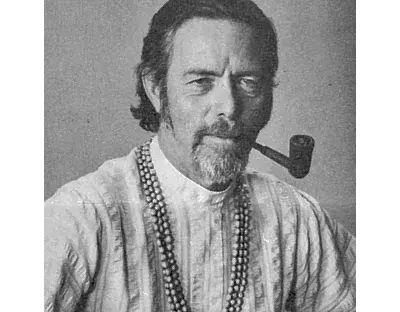
Alan Wilson Watts was a British philosopher, writer and speaker known for interpreting and popularising Buddhism, Taoism, and Hinduism for a Western audience. Born in Chislehurst, England, he moved to the United States in 1938 and began Zen training in New York. He received a master's degree in theology from Seabury-Western Theological Seminary and became an Episcopal priest in 1945. He left the ministry in 1950 and moved to California, where he joined the faculty of the American Academy of Asian Studies.
