Hubert Humphrey Quotes
My philosophy has always been that benefits should percolate up rather than trickle down.
Humphrey, Hubert H. The Education of a Public Man: My Life and Politics. Doubleday, 1976.


The tax rates on income from working is much higher than on income generated from money which is invested. The reason for this is that the government wants economic growth and lowering the tax rate on investment profits will produce more investment which theoretically creates more jobs and strengthens the economy. However, most workers have no choice about whether they have to work. Lowering their tax rate will not induce them to work more. This not only produces a patently unfair burden on the worker compared to people who have capital to invest—usually among the wealthiest Americans. Another problem is that there are many forms of investment that does not produce any benefit for the United States. Many people invest in overseas banks, non American companies. These we tax at a low rate and all the benefits of the investment go to the foreign country.


An income tax had been instituted during the Civil War but had lapsed. Existing taxes were all excise or head taxes—very regressive. Later there was a political movement to bring back the income tax with the intention of taxing all income equally. There was a titanic struggle which culminated in a Constitutional Amendment allowing the income tax. None of the original politicians, for or against, the income tax could never imagine an income tax that would charge lower rates for investment income. That was the entire purpose of the income tax at the beginning—to tax investment (unearned) income. The “capital gains tax” was the creative way of the rich getting back some of what they thought the lost when the income tax was instituted.

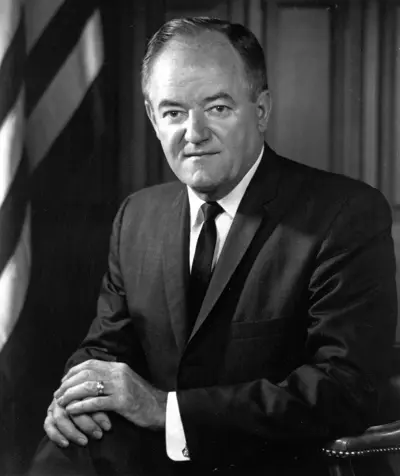
Hubert Horatio Humphrey Jr. was an American politician who served as the 38th vice president of the United States from 1965 to 1969. He twice served in the United States Senate, representing Minnesota from 1949 to 1964 and 1971 to 1978. As a senator he was a major leader of Modern liberalism in the United States. As President Lyndon Johnson's vice president, he supported the controversial Vietnam War. An intensely divided Democratic Party nominated him in the 1968 presidential election. He lost a close race to Republican nominee Richard Nixon.
