George F. Will Quotes
Money is time made tangible - the time invested in the earning of it. Taxation is the confiscation of the earner's time. Although some taxation is necessary, all taxation diminishes freedom.
Will, George F. Statecraft as Soulcraft: What Government Does. Simon & Schuster, 1983.


Issues of freedom and liberty were ongoing elsewhere when the U. S. Constitution was being formulated and debated. Few saw limitations on interest rates as an issue of freedom at that time as there had been a long Biblical prohibition against usury that had become embodied into civil law. Many usury laws still exist today.

This is a very important economic-political quotation. One conservative mantra in the 20th and 21st centuries was that business growth and development will be spurred by tax cuts in the marginal tax rate that the businessperson would have to pay. “Marginal” means the additional tax for each additional dollar of income. However, the development and growth of most businesses, especially the entrepreneurial ones that tend to create the most new high wage jobs. Bill Gates, Henry Ford, Steve Jobs, Thomas Watson Jr. and other creators of great business enterprises, in general do not even consider their potential profit as the most important reward. They are almost always on a mission to change the way people function in the world. They generally want to make money but the driving factor is really the change in society that they will produce. While Gates and other great business creators do not change their business behavior on the bases of marginal tax rates (or any other kind to tax rates for the matter), the 2nd and 3rd generation of business manager who takes over existing companies is motivated in great part by marginal tax rates. Summers and many others argue that not only are the best jobs created by those who are unmotivated by tax rates, but they are the same businesses that tend to produce most of the great innovations of society. Therefore, find other ways to incentivize the entrepreneurs rathefr than marginal tax rate policy.

From the earliest days of the nation a very few people have left the country for reasons which range from seeking more economic freedom (less or no taxes or regulation) or personal liberty (being drafted for a war to which they disapproved and didn’t want to fight in or escaping government invading their privacy). However, while there are countries which on one or two issues may be to some people’s thinking better than the United States, a tiny few have left America while millions pour in—legally and illegally—to have what the overwhelming number of people in the world is one of the greatest places to live in the history of the world. See Cambell’s counter to Norquist: {634644}.

Comment made in the Congressional Congress debates in 1787. This precedes individual taxation. In the debate, Wilson felt state taxation “should accord with the number of freemen” as “it is strange that annexing the name of ‘State’ to ten thousand men, should give them an equal right with forty thousand.”


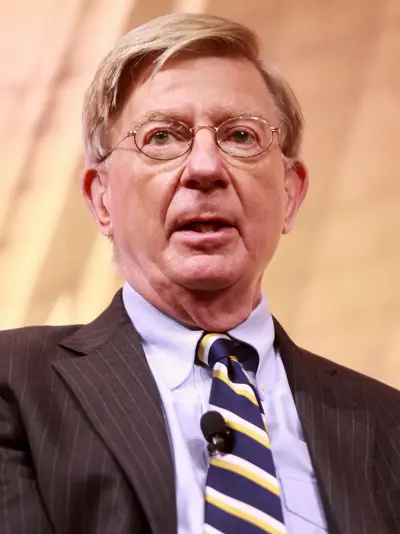
George Frederick Will is an American libertarian-conservative political commentator and author. He writes regular columns for The Washington Post and provides commentary for NBC News and MSNBC. In 1986, The Wall Street Journal called him "perhaps the most powerful journalist in America," in a league with Walter Lippmann (1889–1974). He won the Pulitzer Prize for Commentary in 1977.
