Mark Twain Quotes
Men write many fine and plausible arguments in support of monarchy, but the fact remains that where every man has a voice, brutal laws are impossible
Twain, Mark. A Connecticut Yankee in King Arthur's Court. Charles L. Webster & Co., 1889.

This was a classic debate over universal male suffrage. Rainborough had made a forceful argument for equality as a spokesperson for the Levellers in this famous debate. Ireton (See {619711}) eloquently gave the classic counter-argument that property owners had much more at stake and therefore should have much more of a say on governmental affairs. Early America actually sided with Ireton but modern America holds with Rainborough.


While France was in the midst of a violent revolution, the American debate was on the power and prestige of the Presidency. Then Vice President John Adams was a proponent of a strong executive. Most others were not.


In the election of 1800, the Jeffersonian republicans were pitted against the John Adams Federalists. The latter had seen the revolution as against the excesses of England and King George and not necessarily against the notion of a class society where government served the interests of the upper class—a political battle that is still with us to some extent. The Jewish religion generally recognizes no right of theocratic authority of one man over others with all to follow the laws of God, was theologically very republican. Rabbis were teachers and had no theological or civil authority. To Nones and many other Jews the Jeffersonian ideals were very close to their religious and cultural tradition and to the extent that there has been a party of the classes and a party of the masses, most Jews had gravitated to the latter with the exception of merchants, bankers and others whose economic interests were with the right of center party.

“Familia” in Latin meant in this context, the community or the citizens as opposed to the officials, The Bishop determined the former was under attack by the officials who in the probating of wills and estates would take bribes or levy taxes under “laws” that they would make up on the spot bilking the rightful inheritors of the property and wealth of the deceased. The principle that laws and regulations must be written down in advance and not otherwise, is a fundamental part of Western law today, But as this quotation shows, it was not always such.


The Smithsonian had started a “Department of Living Animals” and had 172 at the time whereas earlier all animals were stuffed. At the time no one was quite sure whether or not there would be any public interest in a zoo. This initial request for $200,000 to buy property on which to place the zoo was turned down as historically zoos were created by royalty and the very rich and didn’t seem democratic to many members of the House. Others however, saw the role of democracy as bringing to ordinary people what had historically been available only to royalty and the wealthy. That view eventually prevailed in America, and the National Zoo is a destination for millions of Americans and foreign tourists. In the next session of Congress, the House reversed itself and voted the appropriation for the National Zoo. See {629320}.


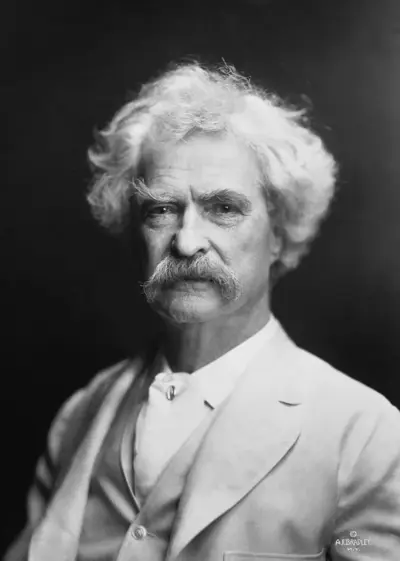
Samuel Langhorne Clemens, known by his pen name Mark Twain, was an American writer, humorist, entrepreneur, publisher, and lecturer. He was lauded as the "greatest humorist the United States has produced," and William Faulkner called him "the father of American literature". His novels include The Adventures of Tom Sawyer (1876) and its sequel, the Adventures of Huckleberry Finn (1884), the latter often called "The Great American Novel".
