Pankaj Mishra Quotes
Many ethnic minorities chafed at the postcolonial nationalism of India and Pakistan, and some rebelled.
Mishra, Pankaj. Temptations of the West: How to Be Modern in India, Pakistan, Tibet, and Beyond. Farrar, Straus and Giroux, 2006.


Churchill was reported to be so angry and exasperated that his face turned red and he was sputtering. During World War II, Gandhi, Nehru and other Indian Nationalists were leading protests against British control of India. This not only bogged down British soldiers surprising the nationalists rather than fighting in Burma or in other war theaters, but India supplied a huge number of battalions to the British Army the world over and if that manpower dried up, the allied war effort would suffer. The American State Department wanted Churchill to announce that after Japan was defeated, there would be a process toward self-government. This way, they thought, the Indians would redouble their effort to defeat the Japanese and stop the then current protests and strikes. Churchill was strongly opposed to any diminution of the British Empire, but beyond that, he knew India quite well and realized that at any hint of Independence the large Muslim minority in India would insist on autonomy or a partition of the country and use sectarian violence and terror to intimidate the Indian Congress party and the British, but the major victims of the terror—the Hindus and the Sikhs would not remain passive, but would retaliate in kind. President Roosevelt was in the midst of planning the Normandy Landings of the D-Day invasion and did not want to pressure Churchill and the British at this point in time, so the door to independence was not opened during the war and Britain had to deal with the protests throughout. However, when, after the war, the Labor Government, started a process toward Indian independence which resulted in exactly what Churchill predicted. At least 2 million Indians were slaughtered in the internecine terrorist cycles of fear and retaliation motivated terror attacks what were so extensive that the British military could not really control it.

As early as 1933, 14 years before Indian independence, there was a movement for a separate Muslim nation within India. Ironically, Hindu India was never a nation in any sense of the word, but was a series of independent principalities much like Italy before its unification. However, with the Muslim conquest of the various Indian states, there was a central authority, ruler, and nation for the first time. Later the Muslims had to argue that India was not a country when it was they who had made it such. When the Muslim Emperors were in power, they argued that India was one country under their authority. But when they lost power, the Muslims argued the other side of the issue.


Muhammad Ali Jinnah and the other Muslim League leaders wanted to stir up India's Muslims in order to prevent Indian Independence from Britain unless India were partitioned and the Muslims could have their own nation. At that point the British and the Congress Party of India—the majority political party were both starting to plan for independence. Jinnah and most of the Muslim nationalists did not want to have Muslims in a Majority Hindu nation. To stop it, they first used fear to try and separate the many Indian Muslims who were politically active from their roles in and loyalty to the Congress Party which although Hindu dominated had Muslim members and officials. All the Muslims who were literate were aware of the terrible revelations of the Nazi Concentration Camps and the attempted extermination of all the Jews of Europe. The "party line" of the Muslim League was that once the British turned the government of India over to the Congress Party, they would turn on the Muslims and exterminate them so that India would be all Hindu. There were no such plans or even suggestions be anyone in the Congress party, the paranoia and the conspiracy theory resonated with many Indian Muslims just as conspiracy theories are believed by some people in every society. In this case, the paranoia that was unleashed by the Muslim League would have tragic consequences as with Independence getting closer many Muslims struck out and preemptively attacked and butchered Hindus and Sikhs who retaliated in kind and the butchery went on all through the Independence process and the partition of India to create a Muslim state—Pakistan. Almost 2 million people would be murdered in the sectarian violence that was unleashed.

Singh turned him down. Note that even before Pakistan was a country, Jinnah and other Muslim leaders had hopes of grabbing much of India as the British partitioned it, and have been trying to do so ever since the inception of Pakistan
The Sikh's had a long history of living under Muslim domination and wanted no part of any more. Patiala was within the Punjab and Jinnah was insisting that the Punjab should be a Province of the new Pakistan because the Punjab was majority Muslim. However, there were many Sikhs, as well as some Hindus, Buddhists, and Christians and none of these wanted to be a part of Pakistan. Further, a significant portion of the Muslim Punjab population also would prefer to join India for many reasons, not the least of which was that they had become used to a democracy where they had complete freedom of religion and civil right as well, and with the exception of Turkey none of the Muslim countries were democratic and based on the Muslim League which did not democratically elect its leaders, Pakistan would not likely be a democracy that guaranteed civil rights (and they were right). So the majority of the people of the Punjab were opposed to becoming a part of Pakistan. The Sikhs were passionate opponents of being a part of Pakistan.

There are two ethnic groups in Fiji. The indigenous Fijians and immigrants from India and their descendants. The Indians originally came to trade and represent a globalized, mercantile culture whereas the indigenous tribes did not have the tradition of business. Over time, the minority Indians were economically more successful than the majority, which tended to resent the Indians. As the Indians were the political minority with no strong tradition of protection of minority rights, they became victims of discriminatory behavior in a nation where the traditional political structure of tribal chiefs and tribes dominated politics. Religion also separated the Hindu Indians from the Christian tribals. In the early 21st century, an Indian was elected prime minister, but this led to a revolt and coup by some traditional tribals. Finally the coup was put down but the society had been split apart and there was continuous argument over rights and whether the coups plotters should be punished.


British colonial economics imported raw materials to England which then exported them back to the colonies as manufactured goods. Gandhi correctly calculated that by minimizing purchase of English cloth, colonial control of India would not be as profitable. Gandhi not only called for the boycott, but called on Indians to spin their own cloth, set an example be spinning himself, and his Congress party adopted the spinning wheel as its logo and symbol which continues today. Narcotics, was at the time not only legal, but British economic interests controlled much of the world narcotics trade. Gandhi’s call for a boycott of narcotics was as much an economic tactic as it was a health measure.


For his seditious activities he was sentenced to penal servitude for life. He escaped and came to America where he entered politics
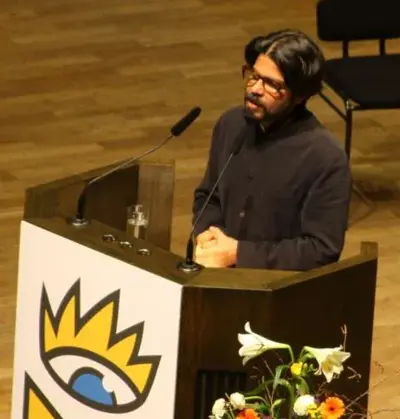
Pankaj Mishra is an Indian essayist and novelist and a recipient of the 2014 Windham–Campbell Prize for non-fiction.
