Mikhail Bakunin Quotes
Liberty without socialism is privilege and injustice; socialism without liberty is slavery and brutality.
Mikhail Bakunin, 1814-1876, Russian Anarchist, Federalism, Socialism, and Anti-Theologism, 1868
Sourced by: Eigen's Political and Historical Quotations


The issue of slavery which had been suppressed in Congress for the first decades of the nation broke out when Missouri statehood was considered. By previous agreement, slavery was not even discussed in Congress but the time period elapsed. Tallmadge not only proposed that no more slaves could come into Missouri {613176} but most shocking to the Southerners was that every person born in the new state would be free at the age of 25. In a generation, there would be no more slavery in Missouri and there would be no economic compensation for slave owners at all. The House of Representatives accepted the amendment, but it failed in the Senate. At that time, Senators were not elected by voters but were appointed by the state legislators and the Southern slave states had a disproportionate share of the senate from a population point of view. But what this quotation shows clearly that a majority of the country in 1819 were opposed to slavery and were willing to end it without compensation.

The Diggers were a religious-economic movement that even today would be considered very radical. They advocated the right of the poor to go onto public lands and farm them—thus the name “Diggers.” Beyond their opposition to the private ownership of land to the exclusion of the poor, Winstanley and the Diggers promulgated another very modern doctrine: That the poor should take the responsibility and have the right to determinine how the society should provide for the poor. A version of this became one of the Mottos of the Poverty Program of 1964. See {616966}.
De Tocqueville was generally concerned about what he saw as an inherent conflict between freedom and equality. Efforts to produce equality can lead in some cases to impingements on some freedoms or rights. Unlimited free rights can produce inequality and a de facto autocracy. Even in modern times America is struggling to find a proper balance.
Socialism in its then pure form had the state owning and controlling all the major assets of the nation. In this sense it was contradictory to individual freedom and hence democracy. However, in the years after Tocqueville’s quotation and the industrial revolution, socialism has gradually moved away from state ownership and operations of all institutions and resources. Democracy has tended to adopt a more regulatory view to control the excesses of unbridled capitalism. The range of democratic nations by the 21st century encompassed differences but some were described as “social democracies” and had some state ownership but were basically capitalistic economies. Even the self-described Communist nations had become heavily capitalistic albeit with less political freedom. At the same time, even the United States—the epitome of 21st century capitalism, owned and controlled a few of the resources and means of production and tended to regulate the others—a substantial difference from the American democracy which Tocqueville studied.


This book became the basic English textbook on socialism. Astoundingly, it sold over 2 million copies at a time when books other than the Bible ever sold in that quantity. The fact that it was so popular alarmed many of the more conservative politicians of the day. A “sweater” was an owner or a manager of a “sweat shop”—a high pressure factory with poor and unsafe working conditions where every once of productivity is “sweated” out of the workers.
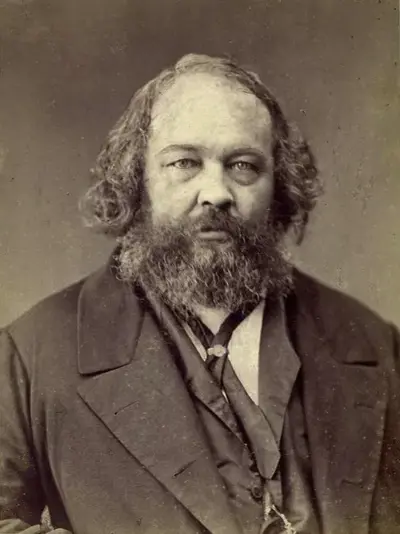
Mikhail Alexandrovich Bakunin was a Russian revolutionary anarchist, socialist and founder of collectivist anarchism. He is considered among the most influential figures of anarchism and a major founder of the revolutionary socialist and social anarchist tradition. Bakunin's prestige as a revolutionary also made him one of the most famous ideologues in Europe, gaining substantial influence among radicals throughout Russia and Europe.
