Swami Vivekananda Quotes
"Learn good knowledge with all devotion from the lowest caste. Learn the way to freedom, even if it comes from a Pariah, by serving him. If a woman is a jewel, take her in marriage even if she comes from a low family of the lowest caste." Such is the law laid down by our great and peerless legislator, the divine Manu.
Vivekananda, Swami. The Complete Works of Swami Vivekananda. Vol. 3, Advaita Ashrama, 1979.

The traditional Hindu social structure established castes – levels of society with Brahmins at the top and untouchables at the bottom. When India gained independence, the caste system was made illegal. Nonetheless, it is still followed by hundreds of millions of Indians. Religiously the Buddhists and the Hindus have had different philosophies. Ilaiah is a Buddhist who opposes the traditional Brahmin social structure and is a supporter of “Dalitization” – a change in the Indian culture to make the Dalits (untouchables) equal de juro and de facto.


Although technically illegal, India has a caste system where Brahmins are on the top and the “untouchables” are at the bottom. Discrimination exists throughout society except in some government programs.


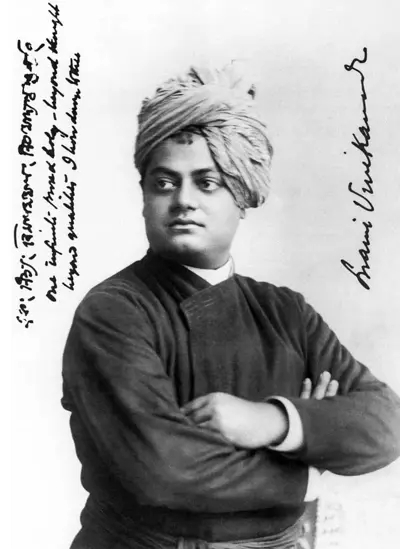
Swami Vivekananda, born Narendranath Datta (Bengali: [nɔrendronatʰ dɔto]), was an Indian Hindu monk. He was a chief disciple of the 19th-century Indian mystic Ramakrishna. He was a key figure in the introduction of the Indian philosophies of Vedanta and Yoga to the Western world, and is credited with raising interfaith awareness, bringing Hinduism to the status of a major world religion during the late 19th century. He was a major force in the contemporary Hindu reform movements in India, and contributed to the concept of nationalism in colonial India. Vivekananda founded the Ramakrishna Math and the Ramakrishna Mission. He is perhaps best known for his speech which began with the words "Sisters and brothers of America ...," in which he introduced Hinduism at the Parliament of the World's Religions in Chicago in 1893.
