Judith Butler Quotes
Law itself is either suspended, or regarded as an instrument that the state may use in the service of constraining and monitoring a given population; the state is not subject to the rule of law, but law can be suspended or deployed tactically and partially to suit the requirements of a state that seeks more and more to allocate sovereign power to its executive and administrative powers. The law is suspended in the name of "sovereignty" of the nation, where "sovereignty" denotes the task of any state to preserve and protect its own territoriality.
Butler, Judith. Precarious Life: The Powers of Mourning and Violence. Verso, 2004, p. 55.


This is just the opposite of the American Democracy in which the government serves the citizens rather than the Fascist opposite notion.


The statement so offended the Lords—the highest court of England—that he was imprisoned by the Lords and not released until he had recanted the position. The argument goes on today in many countries incuding the United States.


One of the major problems in the Palestinian Territory is that a very large proportion of the population is armed with automatic assault weapons. Minor disputes end up with deadly killings and political disputes often result in major shootouts. He argues that it is the government alone that should have the monopoly on weapons and arms.


American law is more ambiguous on this point.
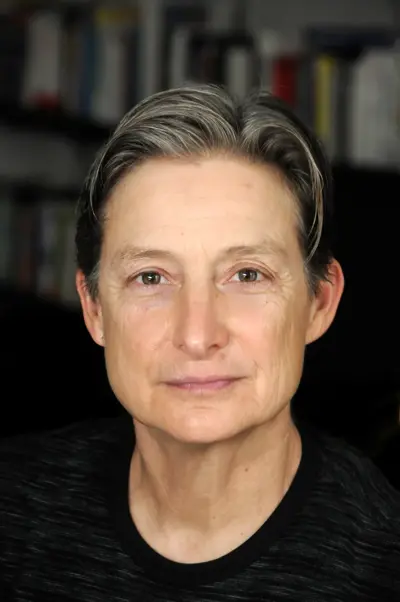
Judith Pamela Butler is an American philosopher and gender theorist whose work has influenced political philosophy, ethics, and the fields of third-wave feminist, queer, and literary theory. In 1993, Butler began teaching at the University of California, Berkeley, where they have served, beginning in 1998, as the Maxine Elliot Professor in the Department of Comparative Literature and the Program of Critical Theory. They are also the Hannah Arendt Chair at the European Graduate School.
