Karl Marx Quotes
Labor, being itself a commodity, is measured as such by the labor time needed to produce the labor-commodity. And what is needed to produce this labor-commodity? Just enough labor time to produce the objects indispensable to the constant maintenance of labor, that is, to keep the worker alive and in a condition to propagate his race. The natural price of labor is no other than the wage minimum.
Marx, Karl. The Poverty of Philosophy. International Publishers, 1963, p. 52.


At the time, the NYC subway was operated by a private companies. Quill worked for the largest, the Interboro Rapid Transit Company. Quill organized the workers and forced major changes in the system.

Sinclair had written an expose of the meat packing industry – the Jungle – which used as its setting the Armour meat packing factory. It changed the way the public thought about the industry, the role of government and regulation. President Roosevelt took up the reform role, and got Congress to Regulate the quality and cleanliness of the meat packing industry. Sinclair, however not only wanted that reform, but also wanted the labor wages and conditions reformed. He referred to the Armour plant as the fortress.


At the time, Australia would not allow Asians in the Country and the United States had severely curtailed Oriental immigration. Ironically, in the 21st century the United States and most of the “white” nations had opened their markets to Asian imports and China, Taiwan, Korea, Thailand all were dominating consumer manufacturing and were in free competition with white labor but there were still de facto restrictions on immigration and Asian guest workers in most white nations.


Bourne was an expert in the history of the the New World


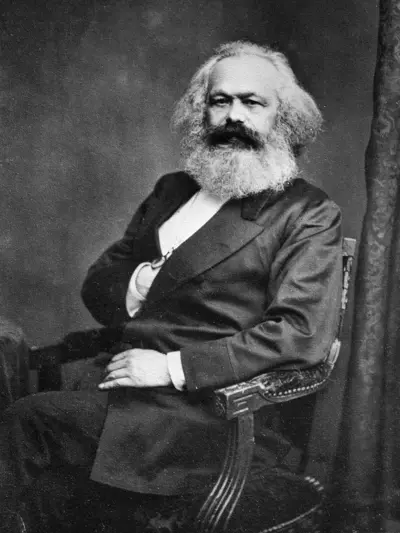
Karl Heinrich Marx was a German philosopher, economist, historian, sociologist, political theorist, journalist and socialist revolutionary. Born in Trier, Germany, Marx studied law and philosophy at university. He married Jenny von Westphalen in 1843. Due to his political publications, Marx became stateless and lived in exile with his wife and children in London for decades, where he continued to develop his thought in collaboration with German thinker Friedrich Engels and publish his writings, researching in the reading room of the British Museum. His best-known titles are the 1848 pamphlet The Communist Manifesto and the three-volume Das Kapital (1867–1883). Marx's political and philosophical thought had enormous influence on subsequent intellectual, economic and political history. His name has been used as an adjective, a noun, and a school of social theory.
