Adam Smith Quotes
Whatever work he does, beyond what is sufficient to purchase his own maintenance, can be squeezed out of him by violence only, and not by any interest of his own.
Smith, Adam. An Inquiry into the Nature and Causes of the Wealth of Nations. Vol. 1, W. Strahan and T. Cadell, 1776, p. 468.


This was written under the name of Ragnar Redbeard. There are a few scholars who believe that it was written by Jack London, but most credit Desmond.


Opposing the concept of a national or central bank:


Abd al-Rahman Ibn Mohammad. He is generally regarded to be the World’s first social scientist. The largest statue in Tunisia of not of a military leader of king, but of this social scientist.


Generally, Jefferson was not in favor of whipping slaves, but this quotation shows that he essentially accepted the basic principles of Southern Slavery—including the one that says if the person does not want to work for you, you may whip, beat, or torture him or her to produce “reasonable work.” This acceptance of slavery and profiting from it, is the terrible blot on the record of the man who otherwise was among the few greatest of Americans.
Frank Wisner headed the recruiting effort which began with his personal friends and college chums. No one had any idea of what skills and standards were needed. Actually the WWII OSS (Office of Strategic Services) had a good track record and profiles of good agents, but Director Donovan lost out in the political infighting and was not selected to head the new CIA. Those who ran that agency did not want to do anything that looked like the old OSS so they began by reinventing the wheel.


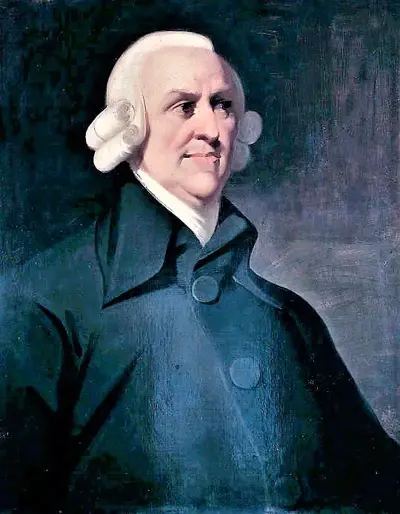
Adam Smith FRSA was a Scottish economist, philosopher as well as a moral philosopher, a pioneer of political economy, and a key figure during the Scottish Enlightenment, also known as ''The Father of Economics'' or ''The Father of Capitalism''. Smith wrote two classic works, The Theory of Moral Sentiments (1759) and An Inquiry into the Nature and Causes of the Wealth of Nations (1776). The latter, often abbreviated as The Wealth of Nations, is considered his magnum opus and the first modern work of economics. In his work, Adam Smith introduced his theory of absolute advantage.
