Thomas Schelling Quotes
Knowing what an opponent values is a necessary condition for deterrence success.
Thomas Schelling, Distinguished University Professor, University of Maryland, Professor of Political Economy, John F. Kennedy School of Government, President, American Economic Association 1960s, Quoted in David P. Auerswald, “Deterring Non-State WMD Attacks”, Political Science Quarterly, Winter 2006-2007
Sourced by: Eigen's Political and Historical Quotations


The President had asked for the views of the Joint Chief’s of Staff. At the time, the major U. S. defense doctrine depended on our nuclear deterrent which if used against the Russians would have meant mutually assured destruction since they had enough of a nuclear arsenal to destroy America as we know it.


Israel started it nuclear weapons program under Perez’s leadership. They do not admit that it is even in existence. Yet all their potential enemies in the Middle East realize that they have enough nuclear weapons capacity that if they are in danger of being overrun, they can literally destroy the attacking nation and all the countries that might be assisting that nation. Before Israel had developed this capability, some in the Middle East had as their objective to destroy the state of Israel and “drive the Jews into the sea”. No one believes that it is now possible to militarily defeat Israel without the attacking nations also being destroyed. For years, Israel has had the military might to conquer any nation in the Middle East and use their nuclear shield to protect them from any interference, but they have not done so demonstrating that the Israeli governments will not use nuclear weapons for any other purpose.


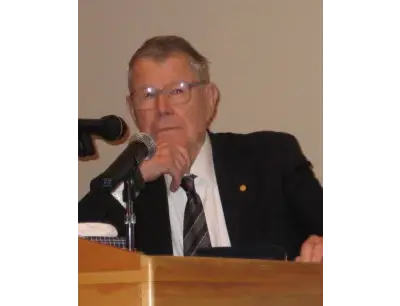
Thomas Crombie Schelling was an American economist and professor of foreign policy, national security, nuclear strategy, and arms control at the School of Public Policy at University of Maryland, College Park. He was also co-faculty at the New England Complex Systems Institute. He was awarded the 2005 Nobel Memorial Prize in Economic Sciences (shared with Robert Aumann) for "having enhanced our understanding of conflict and cooperation through game-theory analysis."
