Lyndon B. Johnson Quotes
Just because we have a button here that will put off a blast over yonder is no reason you want to put that thumb on that button.
Lyndon Baines Johnson, 1908-1973, 36th President of the United States (Democrat, TX), Remark, Nashville, TN, October 9, 1964
Sourced by: Eigen's Political and Historical Quotations


Truman had been briefed on the number of Japanese who committed suicide rather than surrender—including civilians—in Saipan, Okinawa, Iwo Jima, and other locations where United States troops had invaded. He and his experts agreed that the Japanese would not surrender unless there was a new dramatic factor that was outside the usual thinking—the atomic bomb. He was proved right about the warning. Not only did the Japanese ignore it, but they did not even surrender after the nuclear devastation at Hiroshima. It took a second bomb dropped on Nagasaki to motivate the surrender. So even a demonstration with all those Japanese casualties did not cause the surrender until it was repeated.


This was his last publication. He died of a heart attack as the magazine was being printed. Since this was written one other possible use of nuclear weapons has been suggested—namely, retaliation for a biological attack. From a policy point of view, maintaining an arsenal of biological weapons for retaliatory purposes is dangerous and use for retaliation of biological weapons is not very controllable and arguably less humane than a nuclear weapon. His point however still holds. We have to have a national defense policy against many threats and we have to have defense policies that handle all these without nuclear tactics is insufficient to handle any of the threats without causing more problems and we have other weapons and techniques that are just as, if not more, effective. They and systems under development have the major role in our current defense policy.


India built the bomb, and then Pakistan djd at great economic sacrifice.

The background of the statement was Iraq and Saddam Hussein.


Several weeks later the U. S. blockaded Cuba in what became known as the Cuban missile crisis, to remove the Soviet offensive nuclear capability from Cuba.

He was playing the part of Captain Mandrake.

At the time Iran was claiming that its nuclear program was for atomic energy only.

As the atomic bomb evolved to the hydrogen bomb and the test results were learned by political and military leaders, the perception of the danger became much greater, especially when the Russians and French also developed their nuclear weapons. After that, and Einstein’s predictions about the cost and quantity, leaders in the world all became conscious of the danger of Mutually Assured Destruction (MAD), most leaders realized that it was impossible see atomic weapons as anything but defense.


At the time, Pakistan was the only nuclear nation that was very unstable and full of terrorist groups which the government nor the military could control and in some cases even wanted to control. A takeover by militant Islamic terrorists was a possibility or the acquisition of one of the nuclear weapons byr terrorists was then a possibility. India, the United States, and other countries were very concerned.
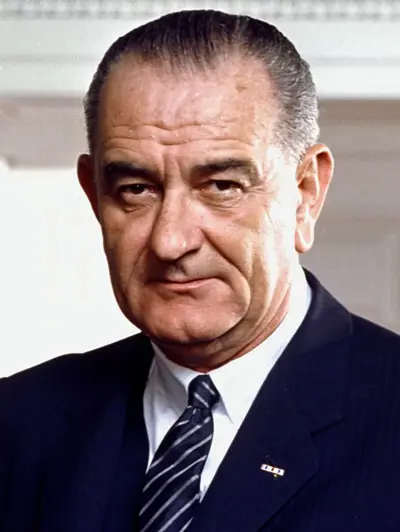
Lyndon Baines Johnson, often referred to by his initials LBJ, was the 36th president of the United States, in office from 1963 to 1969. He served as the 37th vice president from 1961 to 1963 and assumed the presidency following the assassination of President John F. Kennedy. A Democrat from Texas, Johnson was also a United States representative and later majority leader in the United States Senate. Johnson is one of only four people to have served, at various times, in all four federal elected positions.
