Aleksandr Solzhenitsyn Quotes
Just as King Midas turned everything to gold, Stalin turned everything to mediocrity.
Solzhenitsyn, Aleksandr. The First Circle. Translated by Thomas P. Whitney, Harper & Row, 1968, p. 104.


McReynolds vehemently dissented with the majority view in Perry v. United States that the government's action was wrong but that the plaintiff was not entitled to relief. His remarks were so vituperative that this, and other, comments, did not appear in the formal record of the court. See {616652} for an even worse private insult of FDR. McReynolds was a virulent ant-Semite and believed that all Backs were inferior to whites and Separate but Equal was fine policy for the nation and he was not sure the “equal” was necessary.
Honore Gabriel Victor Requiti. The French King had just opened the French National Assembly which contained deputies (delegates) from the clergy, the nobility and the people. The King had made what some deputies thought was a very constructive and responsible speech opening the assembly. Mirabeau observed that as long as there was an absolute monarch in place, even a benign one. It was the presence of a monarch itself that was evil.


Arguing the need to limit the power of the legislature:

Bartolo was the most famous legal expert of his day and for many years thereafter as he died at the age of 44—the height of his career. In Italy, Spain and other nations of Europe there were statutes passed that said if there was no precedent in Roman Law, the writings of Bartolo should dictate the law.

Eggleston was an accomplished writer who had served in the Confederate army of the Civil War. 20 year after the war he wrote a series of articles for the prestigious Northern Atlantic Monthly trying to convey the war from the Southerner’s point of view.
The “Dear Leader” was the name the North Koreans used for ruler Kim Jong-il, 1941-2011.

He served as a liaison with the Russian military officers after WWII. As a result he developed friendships with some who told him much about Stalin.

Soon he had the power of a dictator but he didn’t force his will on the vast majority of the Cubans. His decrees made all the wealthy and the cronies of the dictator Batista outraged and most of them left Cuba. He was a dynamic demagogue and the people handed him dictatorial powers which he did not reject. He was so popular that he was the only leader in the Americas who would give 4 hour speeches and move through the streets without any bodyguards until the United States and dissident expatriates tried to assassinate him. With all that popularity, none the less he would not allow open criticism of his regime and jailed many political opponents. So he indeed became a dictator but never needed the machine gun to maintain power.

This is the argument—an essence of Fascism—of every dictator from Julius Caesar onward. See {640792} for more of his views on dictators.
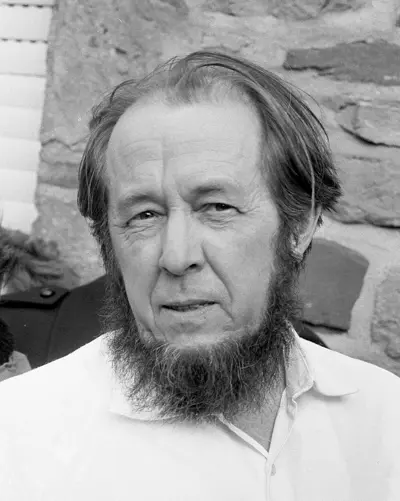
Aleksandr Isayevich Solzhenitsyn was a Russian novelist, philosopher, historian, short story writer and political prisoner. One of the most famous Soviet dissidents, Solzhenitsyn was an outspoken critic of communism and helped to raise global awareness of human rights abuses, the Gulag concentration camp system and political repression in the Soviet Union.
