Jamie Dimon Quotes
I've been regulated my whole life. We have progressive taxes. It's not a free-market free-for-all. I completely understand that society has a perfectly legitimate right to put in structures and regulations and rules that make it fairer, better, cleaner.
Dimon, Jamie. Annual Report 2016: Letter to Shareholders. JPMorgan Chase & Co., 2017.


The Kochs are the very conservative funders, philanthropists, & activists David and Charles Koch. By this definition Abraham Lincoln was certainly a socialist but so were Dwight D. Eisenhower and Ronald Reagan.


The President had decided to aggressively push for railroad regulation to end the rate rebate abuses that were used to support the monopolies like Standard Oil. In vintage Roosevelt tactics, he gave his first major speech on the subject in the setting and forum that would be most opposed to it. The Union League Club of Philadelphia in included the wealthiest men in the area where were most opposed to any Federal Regulation of anything. All the major railroad executives and stock owners and traders were also members. The President wanted to persuade the opponents to change their positions, and sometimes he did. He also was driven by his concept of sports and athletics so that the “opposition” should have “fair notice” for the contest ahead.


His principle was that if all men shared in paying taxes, no one would have to pay so much as to be impoverished. However, the tradition was to exempt so many citizens and classes of citizens that the burden fell heavily on the remainder. Today, in America, no one is exempted, but there are deductions and tax credits given so that some escape much taxation, the poor pay few taxes, and the burden still falls on some—today, the middle class.

Some economic conservatives see little or no role for government. For many of them, in a free market there is no role for government. This quotation, from one of the economic heroes of the conservatives, shows that he not only saw a role for government, but believed that government was essential to the operation of a free market.


That philosophy became embedded in most of our utilities and necessary services. With electricity, the people who live in dense population clusters pay more so that rural residents can obtain electricity at reasonable prices. Internet, cable TV, and telephone are similar. In pharmaceuticals, Americans pay much higher rates while 3rd world countries pay less than their share. The communities who invested in water infrastructure early are today subsidizing those communities who invested little. And people who live in areas of easy water availability subsidize people in the areas where they have abused their water resources or had few to begin with. People who live in safe areas subsidize people who choose to live in flood planes or box canyons susceptible to fires by paying more for insurance so the people in high risk areas can obtain affordable insurance.

in the Meltdown of 2008 Gramm was one of the most ideological deregulators in Congress. As the Meltdown of 2008 hit, he immediately made this statement when few people even knew the extent of what had happened, much less why it happened. Gramm’s instant absolution of deregulation as one of the causes is a classic case of denial. There were few economic issues of controversy that did not contribute to the totality of causes. And a few years later Gramm was one of the very few ideologues who still believed that deregulation did not have a role in the Meltdown and the Great Recession that followed. For a contrast from the expert in his own party, see {638023}.


whether or not to buy luxuries This quotation and {639885} together illustrate why it is so difficult to classify historical politicians in the left-right categories of a future time. Here Gogel seems a strong liberal arguing for progressive taxation and luxury taxes, and tax relief for the poop, while in {639885} he sounds like a 21st century extreme conservative.


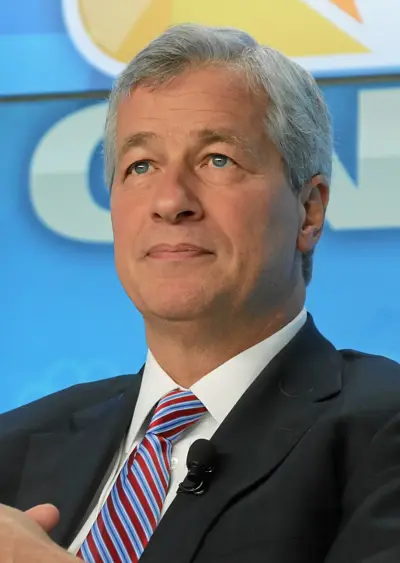
Jamie Dimon is an American billionaire businessman. He is the chairman and chief executive officer (CEO) of JPMorgan Chase, the largest of the big four American banks, since 2005 and was previously on the board of directors of the Federal Reserve Bank of New York. Dimon was included in Time magazine's 2006, 2008, 2009, and 2011 lists of the world's 100 most influential people. Dimon's net worth is estimated at $1.7 billion.
