Paul Krugman Quotes
I've always believed that a speculative bubble need not lead to a recession, as long as interest rates are cut quickly enough to stimulate alternative investments. But I had to face the fact that speculative bubbles usually are followed by recessions. My excuse has been that this was because the policy makers moved too slowly - that central banks were typically too slow to cut interest rates in the face of a burst bubble, giving the downturn time to build up a lot of momentum.
Krugman, Paul. "Dubya's Double Dip?" The New York Times, 2 Aug. 2002.


"Market mispricing" is an economic euphanism for the bankers and major investors of the nation (and abroad) bidding up the prices of the assets in order to continue to squeeze large profits even after they knew that the assets had been far overpriced. Few wanted to stop playing hoping the music would not stop in the economic game of musical chairs. When it did, there were not enough "seats" and failures casued other failures and the contagion spread.


Born thought that her agency was responsible for regulating the new esoteric financial products—derivatives including credit default swaps—for otherwise there would be no regulation at all of financial products that could dwarf the stock and bond market. Summers persuaded her to back off. When the Meltdown of 2008 hit, the huge derivative exposure of the large banks and some insurance companies was so great that it was one of the major causes for the meltdown of the entire banking system. Summers, normally a great economist not only called this one wrong, but later, along with most other government and private economists ignored a very explicit warning—See {637168}, {637986}, and {620038}.


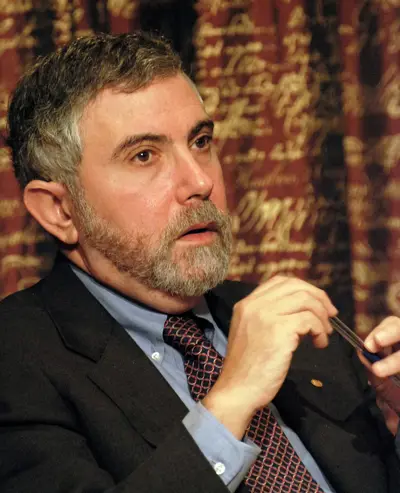
Paul Robin Krugman is an American economist who is the Distinguished Professor of Economics at the Graduate Center of the City University of New York, and a columnist for The New York Times. In 2008, Krugman was awarded the Nobel Memorial Prize in Economic Sciences for his contributions to New Trade Theory and New Economic Geography. The Prize Committee cited Krugman's work explaining the patterns of international trade and the geographic distribution of economic activity, by examining the effects of economies of scale and of consumer preferences for diverse goods and services.
