Donald Rumsfeld Quotes
It’s not the plans, it’s the people. I think we should have Defense Department people.
Rumsfeld wanted Defense Department people running and controlling the civilian government of Iraq after our invasion. General Garner, who was the American appointee to run the civilian government until the Iraqis could have elections wanted State Department, Justice Department and other non military personnel run Iraq.
Donald Rumsfeld, U.S. Secretary of Defense (Republican), U.S. Congressman (Republican, IL), White House Chief of Staff, Statement to Jay Garner, March 2003, Quoted in Thomas E. Ricks, Fiasco- The American Military Adventure in Iraq
Sourced by: Eigen's Political and Historical Quotations

On military or foreign policy matters his view was that presidents ought not to rule anything in or out so that he/she can keep all the options open and not reduce future flexibility.


This was an official publication of the U. S. Army. The First World War had very little affect on future military preparedness At that time conservatives in Congress were very isolationist and military preparedness was not a high priority or even a significant political issue. The Democrats then were more supportive of military spending than the Republicans. It took World War II, for which America was very unprepared, to produce a change in public and political opinion regarding military preparedness.


Written when he was forced to share command with General Francois Kellerman.

The French and English, with larger numbers and more experienced troops and officers, wanted the American units to come under the command or their officers and be integrated into the allied army. However Wilson established the tradition that American troops fighting abroad most always fight as an American Army under American Command. Although resented then and into the 21st century by America’s allies who are expected to fight under American command, it is a tradition that no American major politician has seriously challenged since then.


Monroe was then Secretary of State and Jefferson an ex-President.

Clark had commanded the American and NATO forces in the Serbian War where all the military and political objectives were accomplished with heavy losses to the Serbian’s and none to the allied side—what many think was the most successful war in American History. Like Eisenhower in WWII one great challenge was the political and strategic one of keeping the coalition of all the allied governments working together. His perspective had been like Eisenhower’s which was much wider and geopolitical than most military officers.
Ikle wrote this over a decade before both the military and civilian leaders fell into this trap in the 1994 Iraq War.

1st Earl Baldwin of Bewdley. Though members of the same Conservative Party, Churchill was a major opponent of Baldwin’s peace and “appeasement” efforts and publicly castigated Prime Minister Baldwin. Yet Baldwin, if he could not stave off war, wanted his critic to serve as Prime Minister if war was inevitable. Churchill never had much respect for Baldwin. See {626930}.


See {615006} for but one example of terrible military money and procurement management.
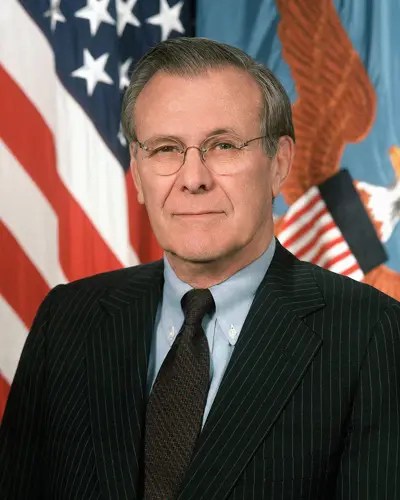
Donald Henry Rumsfeld is a retired American politician. Rumsfeld served as Secretary of Defense from 1975 to 1977 under Gerald Ford, and again from January 2001 to December 2006 under George W. Bush. He is both the youngest and the second-oldest person to have served as Secretary of Defense. Additionally, Rumsfeld was a three-term U.S. Congressman from Illinois (1963–69), director of the Office of Economic Opportunity (1969–70), counsellor to the president (1969–73), the United States Permanent Representative to NATO (1973–74), and White House Chief of Staff (1974–75). Between his terms as Secretary of Defense, he served as the CEO and chairman of several companies.
