Maajid Nawaz Quotes
It's not always the case that Muslims have been theocrats.
Nawaz, Maajid, and Sam Harris. Islam and the Future of Tolerance: A Dialogue. Harvard University Press, 2015.


The doctor argues that the problem of public health in the Islamic world is in large part due to the fact that health care is not organized any more under the control and governance of an Islamic institution—one which is guided by the Koran and Islamic tradition. Other physicians and public health experts believe one central obstacle to public health in Muslim nations is the strong influence that the Mullahs have over the behavior of the population and the medical and health practices that are acceptable and desirable to them are those of the Arabian Desert of the 7th Century or in some more modern interpretations, the medicine of the Islamic world of the 12th century when Islamic Medicine was the best in the World.
by the House of Saud
Despite the fact that the statues were holy symbols to Buddhists, they were offensive to Muslims who say statues as “graven images” prohibited by the Koran. See Wakil Ahmad Muttawakil {608419} and Jamal’s other quotation {604665}.

While not in the Koran, this attributed statement is the basis for the ban on non-Muslims going on a Hajj and going to the most holy Muslim places—Mecca, Mina, Muzdalifa, and Arafat as well as the anti-religious hostility to all religions but Islam which is present in some Muslim countries.

Joseph ben Matthias. The term was coined by Josephus to refer to the fundamentalist, orthodox Jewish view of a proper state, as opposed to a secular government. The Jewish fundamentalist dream of a theocracy came down through modern times. There were ultra-orthodox Jewish groups who opposed the creation of the State of Israel on the grounds that it is not a theocracy and there are some who still want to see Israel transformed. The term became generalized and is applied to any state where the religion is the state and religious leaders dominate and control the state. The ultra orthodox Muslims, as in Iran, are generally the only religious group who have created theocracies or semi-theocracies as Islamic states. See {638106} for the context in which the term was first used.


This is a very important quotation as it focused on one critical difference between historical Islam and all the other major religions and fundamentally on the separation between church and state. In Islam there was a Caliph who was both the political ruler and the religious ruler. In comparison at the time, the Christians had a Holy Roman Emperor who was theoretically the overlord of all the Christian Kings but in reality he really could not exercise total or even much authority over all the other kings. At the same time, there was the Pope who was the religious leader of all the Christians. Since the distinction between Church and state was constantly in flux, the Christian Pope and Holy Roman Emperor were often at odds. The third Abrahamic religion, Judaism, had neither a secular leader or a religious one and no hierarchy other than local. Khaldun observed the theoretical advantage of Theocracy as a model, however he did not analyze the disadvantages among which were the assassination of many Caliphs and the laces. Even the Muslim Arabic states abandoned the idea of a Caliph in modern times until Iran adopted a Theocracy with a single Leader all powerful. However, all the other Arab nations wanted no part of a singular leader for all Muslim nations or even a single civil and religious leader within any other country. Al Qaeda however claimed to be fighting for a return to a Caliphate not only for the current Islamic Nations but for all nations which must be subservient to Islam.

Gabriel exaggerates in the sense that while the quotation is correct for many Muslims, it is by no means true of all. Iran for example is an Islamic theocracy, but Turkey is a 99 percent Muslim nation which is totally secular and in some ways is much more restrictive of Islamic teaching and practice than most secular democracies. The fundamentalist Muslim view of the state and religion is essentially the same as the ultra orthodox Jews and Christians. It is true that a greater proportion of Muslims believe in the merging of civil and religious law than Jews and Christians, but by no means all. The non Arab Muslims are much less likely to see the unity of state and religion.

While the author represents the views of most Islamic Fundamentalists, a similar view is held by many ulta-orthodox Jews and fundamentalist Christians also.


It is precisely for these reasons that large numbers of Muslims consider Ghannouchi and other reformers to be threats to Islam and in need of suppression in order to protect their religion.


This is one of the characteristics of a theocracy—that all law comes from the Deity and religious law is civil law and vica versa. This is similar to the modern views held by the extreme conservative Muslims regarding their Islamic law, Sharia.

After stating his personal Catholic opposition to abortion
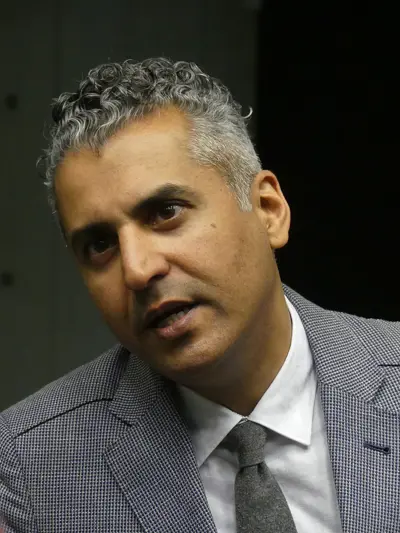
Maajid Usman Nawaz is a British activist and radio presenter. He is the founding chairman of Quilliam, a counter-extremism think tank that seeks to challenge the narratives of Islamist extremists, and the host of a radio show on LBC, every Saturday and Sunday.
