Eric Kandel Quotes
It’s like a presidential press conference. Information goes in and information goes out, but there is not necessarily a connection between the two.
Eric Kandel, Neuroscientist, Nobel Laureate in Medicine, Using a political analogy to explain a neurological disorder, The Charlie Rose Show, July 22, 2010
Sourced by: Eigen's Political and Historical Quotations

Just quotation tells us something about Mrs. Roosevelt that is fascinating. Note that she tells us that she had her usual press conference. She typically had several press conferences a week. Before Mrs. Roosevelt, first Ladies did not have press conferences by themselves. She did almost wherever she went. She had more than the President did. And the presidents staff rarely knew what she was going to say. They found out about it in the next day’s newspapers. No first lady before or since then has ever had as much access to the press or as independent access as Mrs. Roosevelt.

This was her response to Sander Vanocur {618913}

The George W. Bush administration was a very ideological one as opposed to pragmatic. They would not tolerate public officials who would say anything that might undermine an administrative ideological position. In particular, they did not want government scientists releasing any data or information that was not totally consistent with their ideology and program. They introduced a new policy within the government whereby no one could talk to a reporter or make a public speech or deliver a professional paper without first getting approval of administration “public affairs” agents first. Government scientists and other officials had never before been censored like this. Important scientific studies were not made public where they might not support the administration ideological positions. This is how the NASA public affairs official explained his role.
He served Presidents Reagan, Clinton, and both Bushes


Reagan, Ford, Nixon, Clinton


_0_PostageStamp_47x47.jpg "Chairman of the Joint Chiefs of Staff Navy Adm. Mike Mullen gives an interview to John Dickerson during the CBS news program Face the Nation in Washington, D.C., July 5, 2009. During the interview, Mullen discussed the wars in Iraq and Afghanistan, North Korea's recent missile tests and his recent visit to Russia. (DoD photo by Mass Communication Specialist 1st Class Chad J. McNeeley, U.S. Navy/Released)")

This is the earliest use of “spin” and “spin doctors” in a political context that we have found.


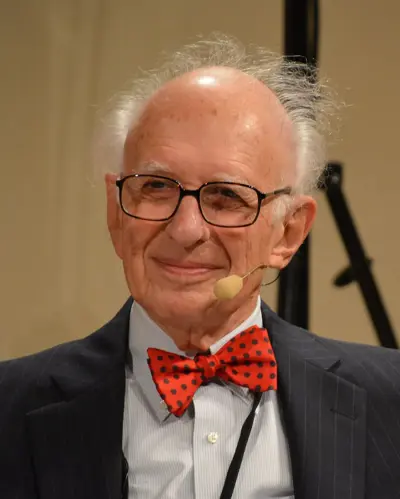
Eric Richard Kandel is an Austrian born-American medical doctor who specialized in psychiatry, a neuroscientist and a professor of biochemistry and biophysics at the College of Physicians and Surgeons at Columbia University. He was a recipient of the 2000 Nobel Prize in Physiology or Medicine for his research on the physiological basis of memory storage in neurons. He shared the prize with Arvid Carlsson and Paul Greengard.
