Al Capone Quotes
It's a racket. Those stock market guys are crooked.
Cockburn, Claud. In Time of Trouble: An Autobiography. Rupert Hart-Davis, 1956, p. 237.

While not every person in the stock market was dishonest, a large number were, and the system itself was inherently unfair and disadvantaged the average investor. Despite the many reforms attempted over the years, as the 2008 meltdown proved, the same problem was still with us. Capone was essentially right then and even today.


The then attorney general had begun a series of investigation which discovered that most of the major Wall Street brokerage houses were engaged in systematic frauds to cheat small investors. One dramatic fraud he uncovered was that the research expert analysts of major firms would recommend the stock of businesses that their firm was doing investment banking for even when they knew that the companies were not doing well or were even in deep financial trouble. See {627544}.

Greenspan was not the amoral fool that this quotation makes him seem. Despite the fact that he was the most important financial officer of the country, he had an ideological faith that a free market was self-corrective in a democracy. The financial industry would police itself he believed. He also trusted the self interest of the financial corporations to restrain them from getting too greedy -- {637989}. He and many others were wrong and most Americans paid the price.


Roosevelt was on a crusade to eliminate the vicious monopolies and trusts of the time. The number of terms he used to describe them was large but this has become the most memorable and most frequently quoted. See {585244} for some of the other terms he used. While this phrase was original with FDR, his relative, Theodore Roosevelt, used the term “malefactors” in a similar meaning in {585244}.

The States sold bonds to finance the Revolutionary War. Some states had better prospects for redeeming their bonds than others. Georgia, South Carolina and North Carolina in particular had poorer prospects than most and their bonds were selling at about 25 cents on the dollar. Alexander Hamilton, then the Secretary of the Treasury, wanted the new Federal government to assume the state’s war debt and pay off the bonds. He made his proposal for how he would accomplish this on January 14, 1790. He delivered his report and proposal to Congress “Report on the Public Credit”. As soon as Hamilton’s proposal was read in Congress, sophisticated speculators set off for the Southern States to buy up as many bonds as they could before the owners found out that a Federal bail-out was under serious consideration. They could easily double, triple or even quadruple their money. To Jackson this was gross immorality. Other representatives had a different point of view. See {619928} & {619939}.
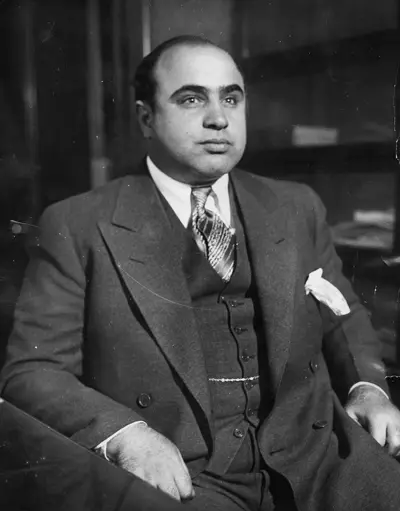
Alphonse Gabriel Capone, sometimes known by the nickname "Scarface", was an American gangster and businessman who attained notoriety during the Prohibition era as the co-founder and boss of the Chicago Outfit. His seven-year reign as a crime boss ended when he went to prison at the age of 33.
