Gavyn Davies Quotes
It was an interesting question as to whether the BBC had a future in the digital world, and what form of market failure could justify the licence fee system.
Davies, Gavyn, et al. The Future Funding of the BBC: Report of the Independent Review Panel. Department for Culture, Media and Sport, 1999.


See Fred W. Friendly for an almost as harsh an incitement: {611294}

The “folks” were private corporations want to run schools and have won some contracts to operate Charter Schools. They argue that the free market should prevail when it comes to education and schools should not necessarily be run by local governments. Corporations should be given a chance in a “free market.” However, as Molnar observes, there is more than a little hypocrisy in the these educational corporations totally depend on public, tax dollars for the existence. Ironically, there is a sound market for elite private schools which are in a free market which are funded with private money. However, these educational corporations have chosen NOT to compete in this private arena. They only want public money. Critics argue that they are not very good at operating schools but are quite skilled at politically obtaining taxpayer money. So far there is no data from objective studies which shows that these educational corporations can operate better or less expensive schools.

The Commerce Department was then in charge of Radio regulation and policy. Hoover, a great administrator and businessman, had a terrible record with policy making. He almost always zigged when he should have zagged. He let General Douglas MacArthur loose to brutalize protesting veterans, would not use the Federal Government to provide any relief or stimulus as Roosevelt did in the Great Depression, and here, where he took a very left wing position on Radio Advertising, he was wrong again as it was the very thing he wanted to avoid that provided all the sponsors resources for all the great radio program development.

This is an incredible quotation by the American political standards of the 21st century. Coolidge was President and the conservative wing of the Republican Party controlled Congress. There were thousands of radio stations operating. The small commercial and amateur, and community radio stations were thriving but they could only afford small transmitters that only reached the local area. The large commercial radio stations wanted by be able to broadcast to the entire country (see {641989})and could afford huge transmitters but if a local station was on the same frequency the small station would dominate in the local area and not the large stations. The large corporations then lobbied the Federal Radio Commission and the Congress and this policy was adopted. Thousands of small radio stations were kicked off the airwaves so that the large corporate stations could have “clear channels” across the country. It turned out that the small entities did not have equal rights and it was a blatant Federal handover to the large corporations. (See {641992}).)Small stations were only able to broadcast with the advent of FM which only became economically feasible in the late 1940s although FM was patented in 1933.


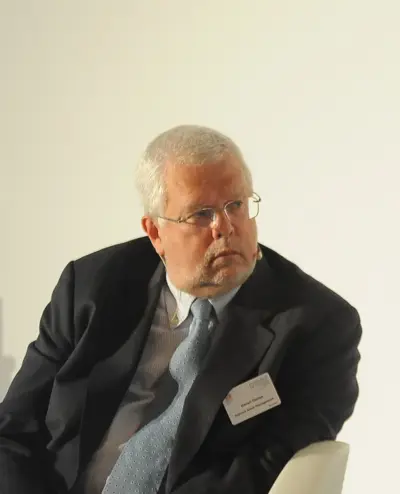
Gavyn Davies, OBE is a former Goldman Sachs partner who was the chairman of the BBC from 2001 until 2004. On 28 January 2004 he announced that he was resigning his BBC post following the publication of the Hutton Inquiry report which heavily criticised the organisation.
