F. W. de Klerk Quotes
It was a day of liberation-not only for black South Africans but also for us white South Africans. Suddenly, the burden of three hundred and fifty years had been lifted from our shoulders. For the first time we could greet all our countrymen without guilt or fear as equals and as fellow South Africans. When I awoke that morning I was still the president of South Africa. When I went to bed the mantle had passed from me to Nelson Mandela. Few heads of government could ever have laid aside their high office with a greater sense of accomplishment, regardless of the uncertainties of the future.
He and Mandella were both awarded the Nobel Peace Prize for engineering what was probably the largest transition of power without violence in world history.
F. W. de Klerk, South African Prime Minister & President, Nobel Peace Prize Laureate, Reference to the end of apartheid and the passing of the Presidency to Nelson Mandela, The Markkula Center for Applied Ethics, Reflections on Working Toward Peace
Sourced by: Eigen's Political and Historical Quotations


The power structure of England and the English administrators of South Africa were strong advocates of racial equality at the beginning of the 19th century. They insisted on equal administration of law. However the Boer white population could think of nothing more absurd. In a sense the Boers were much like the Southern Whites at the same time. The South African government however could not enforce its equality policies in the rural area – the majority of South Africa at the time. When democracy and self rule came to South Africa, the racially moderating force of the English was minimized and the majority of South Africans wanted a racially segregated society. Apartheid resulted.


South Africa’s transition from apartheid white minority rule to an interracial society with Black majority rule was one of the great political achievements in history. The Black leadership set a tone of reconciliation and inclusiveness that there was neither back retribution and vengeance, nor extensive white flight. Tutu and Nelson Mandella were two of those most resonsible for the leadership, but the good will and Christian charity of the South African blacks was the key to the success where all other white dominated African nations were NOT able to transition without extensive violence and/or flight.


Essentially this quotation led to a major war and yhrn a later war of independence for Blacks in South Africa. Porter was the Attorney General of the English Cape Colony in South Africa. In an early legal ruling he observed that South Aftica was a colony under English law which did not permit discrimination on the basis of skin color. However, there was a large proportion of Afrikaners—whites of Dutch Ancestry who were culturally strong racists and saw the Blacks as a combination of potential rivals for land and a potential subjegated labor force. They tended to leave the Capetown area and English law. The Afrikaners ended up in a major war—the Boer War—against the English and although the English won the war, the Afrikaners won the political peace and ended up dominating South Africa and imposing apartheid. The Blacks of the mid 20th century had if nothing else, the 100 year old legal and moral precendent from Porter’s opinion which justified the ANC leading the attack on apartheid which finally succeeded. It took 100 years and millions of suffering and dying people but finally, the law of South Africa was as Porter had stated it, and since the Blacks were in the great majority, the Whites became the minority, but due to the ANC leadership of men like Nelson Mandella, the Blacks did not seek revenge on the Afrikaner whites although there was resentlent for generations.


The Boers were lower class, uneducated, farmers from Holland who came to South Africa before the English did. They were at the bottom of the Dutch socioeconomic ladder. Unlike the English who were interest in establishing a trading colony, the Boers just wanted to own and farm the land and use blacks as slave or cheap labor. The Dutch Government and Trading companies lost interest in South Africa as there were much more profitable parts of the world, and they felt no obligation to the Boers whom they were glad to be rid of. So the Boers found themselves having to follow the British laws and rules of the British Colonial Office. Slavery was outlawed, and Blacks could be educated and become citizens under British law. They could own land, and contest the right of the Boers who had settled in some uninhabited land and some that was owned by Black tribes. The Blacks outnumbered the whites in general and the Boers, and there were educated Blacks who “outclassed” the still relatively uneducated Boers. So the Boers, fighting for their “way of life” set up their own area in Southern Africa and claimed independence. But Blacks claimed that it was their land and looked to the British to exercise English law. The Boer war ensued. Although the Boers lost the war, the bred at a much faster rate than the English, many of whom did not even have their families in South Africa. By the end of WWII, the Boer white majority controlled the government and kept the majority Blacks from voting and having full citizenship rights. They dominated Apartheid South Africa until the Black Revolutionists obtained control and although Black and white relations are better in South Africa than most countries, the extemeist Boers and most militant Blacks are in political, but not violent, conflict. Churchill and the British have always perceived themselves as being caught in the middle between the Boers and the Blacks.

After signing the Emancipation Proclamation:


The statement was made just before Kenyan Independence was official. His statement was surprising to many people who perceived him as a racist and anti-white. There was a fear that whites would no longer be welcome in Kenya after independence, but Kenyatta’s leadership maintained a pluralistic society.


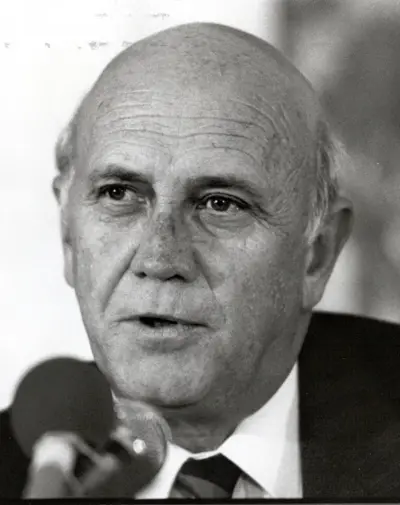
Frederik Willem de Klerk OMG DMS is a South African retired politician, who served as State President of South Africa from 1989 to 1994 and as Deputy President from 1994 to 1996. As South Africa's last head of state from the era of white-minority rule, he and his government were forced to dismantle the apartheid system and introduced universal suffrage. Ideologically a conservative and an economic liberal, he led the National Party from 1989 to 1997.
