F. W. de Klerk Quotes
We were asking for a clear mandate to normalize the political process; to negotiate a new constitutional dispensation; to remove racial discrimination; to promote economic effectiveness; to maintain law and order; and to remove mistrust by building bridges between our divided communities.
F. W. de Klerk, South African Prime Minister & President, Nobel Peace Prize Laureate, Campaign Speech, 1989
Sourced by: Eigen's Political and Historical Quotations

He and Mandella were both awarded the Nobel Peace Prize for engineering what was probably the largest transition of power without violence in world history.


The upper socioeconomic classes are generally less rascist then the lower classes in the United States as well as England and South Africa. The counter argument given by the lower classes are that the upper classes have the money to insulate themselves from the negative aspects of desegregation and the lower class whites have to bear the brunt of desegregation. However, in South Africa, the English of all socioeconomic classes were far less enthusiastic about apartheid then were the Boers. The latter were farmers who wanted the land; the former were traders who could succeed even of the Blacks had their land and were given political rights.


The Boers were lower class, uneducated, farmers from Holland who came to South Africa before the English did. They were at the bottom of the Dutch socioeconomic ladder. Unlike the English who were interest in establishing a trading colony, the Boers just wanted to own and farm the land and use blacks as slave or cheap labor. The Dutch Government and Trading companies lost interest in South Africa as there were much more profitable parts of the world, and they felt no obligation to the Boers whom they were glad to be rid of. So the Boers found themselves having to follow the British laws and rules of the British Colonial Office. Slavery was outlawed, and Blacks could be educated and become citizens under British law. They could own land, and contest the right of the Boers who had settled in some uninhabited land and some that was owned by Black tribes. The Blacks outnumbered the whites in general and the Boers, and there were educated Blacks who “outclassed” the still relatively uneducated Boers. So the Boers, fighting for their “way of life” set up their own area in Southern Africa and claimed independence. But Blacks claimed that it was their land and looked to the British to exercise English law. The Boer war ensued. Although the Boers lost the war, the bred at a much faster rate than the English, many of whom did not even have their families in South Africa. By the end of WWII, the Boer white majority controlled the government and kept the majority Blacks from voting and having full citizenship rights. They dominated Apartheid South Africa until the Black Revolutionists obtained control and although Black and white relations are better in South Africa than most countries, the extemeist Boers and most militant Blacks are in political, but not violent, conflict. Churchill and the British have always perceived themselves as being caught in the middle between the Boers and the Blacks.

Helen Suzman, 1917–2009 was a white South African member of Parliament representing Capetown. She came from a Jewish English background and was the leader of the Progressive Party which was the opposition to the Nationalist party that had established the Fascist style Aparteid government where the 10% white population dominated and ruled the 90% black and Asian population. When all the other progressive MPs lost their seats, Suzman was the only member of the South African Parliament who totally opposed the racist apartheid of South Africa. She had little power to change or block Apartheid laws being only a single MP, but her eloquence and vigorous verbal demand for freedom and equality for blacks provided a focal point for foreign boycotts to produce change in South Africa. However, she did not publicly advocate revolution and violence. As a result most of the militant blacks did not value or even follow her activities to end apartheid, and many had no idea who she was. However, Mandela, imprisoned on Robin Island at the time, not only followed her activities, but sent frequent compliments and notes of encouragement to white opponents of the government and apartheid even though many did not support the armed violence that had become necessary to produce change. Mandela knew that there would be core of a white leadership that would favor one-man-one-vote which would make South Africa a black-dominated government when the apartheid Nationalists could be defeated. Mandela was like a great chess player playing a current game but thinking 5 and 6 moves in advance even while in prison. Suzman was one of Mandela’s leading white supporters after the regime change.


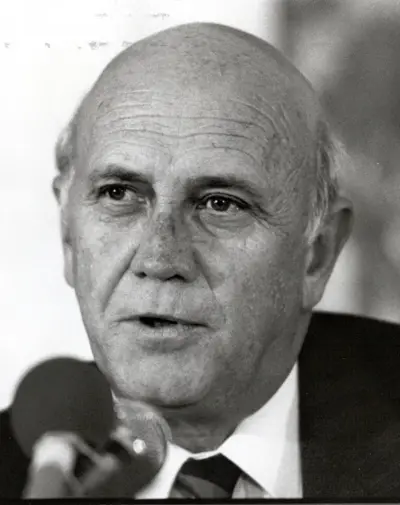
Frederik Willem de Klerk OMG DMS is a South African retired politician, who served as State President of South Africa from 1989 to 1994 and as Deputy President from 1994 to 1996. As South Africa's last head of state from the era of white-minority rule, he and his government were forced to dismantle the apartheid system and introduced universal suffrage. Ideologically a conservative and an economic liberal, he led the National Party from 1989 to 1997.
