Henry Ford Quotes
It is well enough that the people of the nation do not understand our banking and monetary system for, if they did, I believe there would be a revolution before tomorrow morning.
Henry Ford, 1863-1947, Unsuccessful Republican Michigan U. S. Senatorial Candidate [1918], Industrialist & Philanthropist, Quoted in Wickliffe B. Vennard Sr., The Federal Reserve Hoax, 1962
Sourced by: Eigen's Political and Historical Quotations


The building was named after Marriner Eccles.


This is an oft quoted statement because of the Great Depression which occurred the following year after Strong had passed away. The Federal Reserve followed the lead of President Hoover and did nothing while they watched the nation’s money supply shrink a third over the next 3 years, making a business comeback very difficult. If Strong had lived longer, he might have persuaded the others to increase the money supply and act as the nation’s safety valve. As the President of the New York Bank, he was the first among equals.


The legislation creating the Federal Reserve Board was then being debated. A few days later it passed despite reservations from Lodge and others. The powers relegated to the Federal Reserve Board have been debated ever since.
The Congressman was notorious for his extreme and unusual views of things. See {606976} for another of his extreme statements which turned out to be untrue. McFadden quotations are sometimes used to show that there is almost no limit to how absurd a view a politician in general, or a member of Congress in particular, might take and make public.

His “Real Plan” had stopped the Brazilian hyperinflation when he was Finance Minister.


The assumption was that money would always be backed by gold or silver. In effect, raising or allaying the money was to change the amount of gold or silver that a particular denomination of money would be able to be exchanged for. This is one of the interesting proofs that these processes did nothing economically—for if they could, no one would want the money. This has always been a weakness or a strength—depending on one’s political point of view—of a gold standard.

This is the first major history of banks written in the United States.
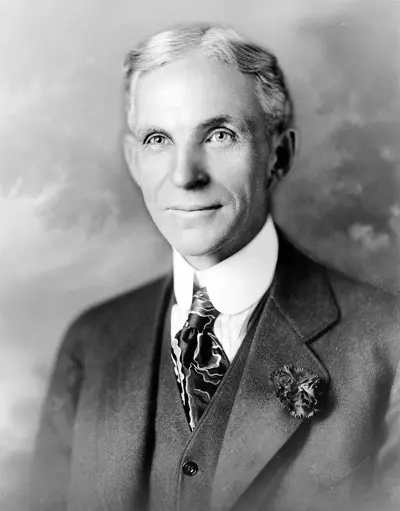
Henry Ford was an American industrialist, business magnate, anti-Semite, and founder of the Ford Motor Company and chief developer of the assembly line technique of mass production. By creating the first automobile that middle-class Americans could afford, he converted the automobile from an expensive curiosity into an accessible conveyance that profoundly impacted the landscape of the 20th century.
