Louis Thomas McFadden Quotes
Mr. Chairman, we have in this Country one of the most corrupt institutions the world has ever known. I refer to the Federal Reserve Board and the Federal Reserve Banks… The Fed has cheated the Government of these United States and the people of the United States out of enough money to pay the Nation's debt. The depredations and iniquities of the Fed has cost enough money to pay the National debt several times over. This evil institution has impoverished and ruined the people of these United States, has bankrupted itself, and has practically bankrupted our Government.
The Congressman was notorious for his extreme and unusual views of things. See {606976} for another of his extreme statements which turned out to be untrue. McFadden quotations are sometimes used to show that there is almost no limit to how absurd a view a politician in general, or a member of Congress in particular, might take and make public.
Louis Thomas McFadden, 1876-1936, U. S. Congressman (Republican, PA), Attack on the Federal Reserve Board, House Debate, 1934
Sourced by: Eigen's Political and Historical Quotations

In 1933, there was still a some of anti-Semitism in America. The persecution of Jews in Germany was very clear at the time, just from the statements and writings by Adolf Hitler and other high level government officials and the laws that they were instituting and proposing. McFadden was one of the extreme isolationists in Congress at the time. They knew very little of the rest of the world, and believed the false assurances provided by German officials and American anti-Semitic, Fascist, pro Nazi partisans. McFadden’s statement was not only contrary to fact, but is among the most naïve of Congressional speeches.


The very act of printing money created a debt—at the time and until the Nixon Administration which went off the gold standard—the government owed the gold or silver and the spicie—the printed money—was a promissory note.


The building was named after Marriner Eccles.


There actually are restraints on how much paper money a government will issue, but unlike with a gold standard where the restraint is external and controlled by how much gold the country can amass. However, with paper money the restraints area all internal. If too much money is printed, the value of the money relative to gold, silver and other nation’s money will go down and imports will become more expensive. Excessive printing of money can easily produce inflation. However, the internal restraints can be overcome by the government’s need to raise money for war, debt or other purposes. So Paul and many other politicians have a deep distrust of paper money not backed by Gold or Silver. In the United States however, the Government does not control the money supply or the printing policies of money. This is under the control of the Federal Reserve Board which while appointed by President’s as terms expire, have a great deal of independence both from the Executive and Legislative Branches. For that reason Paul is even more distrustful when the Federal Reserve decides to print money. See {629491} for his unsuccessful effort to abolish the Federal Reserve Bank.


The legislation creating the Federal Reserve Board was then being debated. A few days later it passed despite reservations from Lodge and others. The powers relegated to the Federal Reserve Board have been debated ever since.


The ‘Fed’ refers to the Federal Reserve Board, the strength of which lies in its independence from politics. Some, however, believe that there should not be any entity that performs a major function in our society which is not accountable to the Executive Branch or the Congress or both.


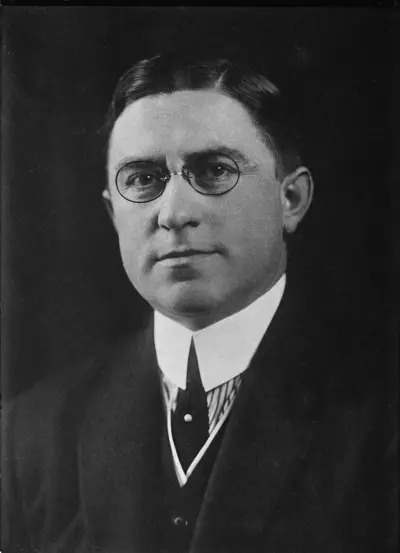
- Born: July 25, 1876
- Died: October 1, 1936
- Nationality:
- Profession:
Louis Thomas McFadden was a Republican member of the United States House of Representatives from Pennsylvania, serving from 1915 to 1935. A banker by trade, he was the chief sponsor of the 1927 McFadden Act, which rechartered the Federal Reserve System in perpetuity, liberalized branch banking for national banks and increased competition between member and non-member banks. He later became an opponent of the Federal Reserve System and anti-Semitic conspiracy theorist.
