Adam Smith Quotes
It is unjust that the whole of society should contribute towards an expense of which the benefit is confined to a part of the society.
Adam Smith, 1723-1790, Scottish Political Economist, The Wealth of Nations, 1776
Sourced by: Eigen's Political and Historical Quotations


While this is a common complaint in the American political dialogue at the beginning of the 21st century, it is interesting that this was the conclusion of a foreign political scholar studying that period—one who was generally a great admirer of America.

Explanation for his assassination of President William McKinley:


This important statement would not have been a noteworthy quote as so many have said it before, except for the fact that she was writing as a spokesperson of Nationalist China and she was the wife of the Nationalist Party leader, Chiang Kai-Shek. And the great failure of Chiang’s governance was the corruption and the excessive exploitation of the Chinese people by the wealthy. Madame Chaing, educated at Vassar College, knew just what to say to Americans and she mustered incredible support for the Nationalist cause most of which would never have been forthcoming if Americans knew the truth about the Nationalist Government. It was so corrupt, that the vast majority of the people aided the Communists in defeating Chaing, expelling him from the mainland, and relegating his government to Taiwan. Madame Chaing’s hypocrisy was legend. See {615696}.

The same greatest issue was still before the people a century later. See {633217} , {635104} & {630538}.


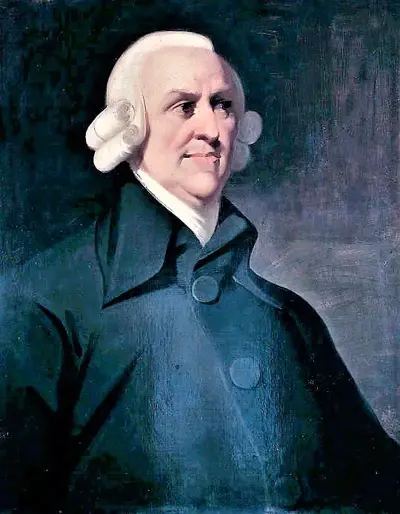
Adam Smith FRSA was a Scottish economist, philosopher as well as a moral philosopher, a pioneer of political economy, and a key figure during the Scottish Enlightenment, also known as ''The Father of Economics'' or ''The Father of Capitalism''. Smith wrote two classic works, The Theory of Moral Sentiments (1759) and An Inquiry into the Nature and Causes of the Wealth of Nations (1776). The latter, often abbreviated as The Wealth of Nations, is considered his magnum opus and the first modern work of economics. In his work, Adam Smith introduced his theory of absolute advantage.
