Thomas Paine Quotes
It is the nature and intention of a constitution to prevent governing by party, by establishing a common principle that shall limit and control the power and impulse of party, and that says to all parties, thus far shalt thou go and no further. But in the absence of a constitution, men look entirely to party; and instead of principle governing party, party governs principle.
Many of the Founding Fathers had a deep suspicion of political parties or “factions” as Madison referred to them. However, after Washington’s two non partisan administrations, political parties became dominant in American politics when John Adams and Thomas Jefferson presented two very different views of government and the nation was divided.
Thomas Paine, 1737-1809, British American Political Philosopher, First Principles of Government, July 1795
Sourced by: Eigen's Political and Historical Quotations


In a 1949 dissenting opinion in Terminiello v. Chicago Jackson claimed the majority view would “convert the Bill of Rights into a suicide pact.”


The English Constitution is not as binding on the English government as is the Amercan Constitution. In the English system, the government in power can override the constitution although the rarely do so out of respect for the system. In America, the Constitution is much more controlling and hence would be seen to count for more. In many third world countries, the ruler can “suspend” the constitution in a national emergency.

This was an insult to the George W. Bush administration which had stretched the Constitution more so than any previous administration, had asserted Presidential powers that had never been asserted before and had had several of its more controversial policies and practices overturned by the Supreme Court.


There are many Americans who resent the fact that states and localities publish official documents in Spanish and other foreign languages as well as English. They often argue that the Founders wanted English to be the only language of the American government. It comes as a shock and surprise that the Constitution was published in English AND German to reach the many German immigrants who were a part of early America.


Despite Ziglar’s and other officials pointing out the illegality, illegal sweeps and arrests were made without warrants or constitutional requirements.


Powell was the Secretary of State and Addington kept advising the administration that as long as the President was acting in defense of the country in his capacity as Commander in Chief, he did not have to obey any existing laws that had been Constitutionally passed which in the opinion of the President restricted or limited the President or the executive branch. Addington was an attorney and Assistant to the Vice President, but he was given much responsibility for administration policy. Powell the Secretary of State of the Administration could not have disagreed more and although most politicians including Republicans disagreed with the Addington thesis, Powell was one of the few Republicans to criticize the Addington position.
There are many countries that adhere to a rule of law, for which their Constitution is the fundamental document providing a framework for their legal system which is adhered to. A few nations which are strong adherents to the rule of law, but have no constitution; the instead have a very strong system of Common Law which establishes their legal precedents and a legislative tradition of restraint which provides fixed principles (Great Britain and Israel are two good examples). But the biggest problem for many countries in not adhering to the rule of law, is having a written constitution and then ignoring it when making legal decisions for the nation, Balaguer’s quotation here is typical of the attitude which causes nations with fine constitutions to function without any serious adherence to rule of law.
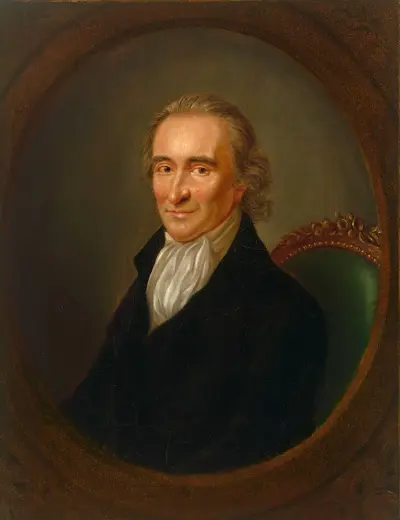
Thomas Paine was an English-born American political activist, philosopher, political theorist, and revolutionary. He authored Common Sense (1776) and The American Crisis (1776–1783), the two most influential pamphlets at the start of the American Revolution, and helped inspire the patriots in 1776 to declare independence from Great Britain. His ideas reflected Enlightenment-era ideals of transnational human rights. Historian Saul K. Padover described him as "a corsetmaker by trade, a journalist by profession, and a propagandist by inclination".
