Adam Smith Quotes
It is the highest impertinence and presumption, therefore, in kings and ministers, to pretend to watch over the economy of private people, and to restrain their expense, either by sumptuary laws, or by prohibiting the importation of foreign luxuries. They are themselves always, and without any exception, the greatest spendthrifts in the society. Let them look well after their own expense, and they may safely trust private people with theirs. If their own extravagance does not ruin the state, that of their subjects never will.
Adam Smith, 1723-1790, Scottish Political Economist, The Wealth of Nations, 1776
Sourced by: Eigen's Political and Historical Quotations


The U. S. was very protectionist in its early history. Grant overestimated the time that it would take for us to change by about 100 years.


From the earliest days of the nation a very few people have left the country for reasons which range from seeking more economic freedom (less or no taxes or regulation) or personal liberty (being drafted for a war to which they disapproved and didn’t want to fight in or escaping government invading their privacy). However, while there are countries which on one or two issues may be to some people’s thinking better than the United States, a tiny few have left America while millions pour in—legally and illegally—to have what the overwhelming number of people in the world is one of the greatest places to live in the history of the world. See Cambell’s counter to Norquist: {634644}.


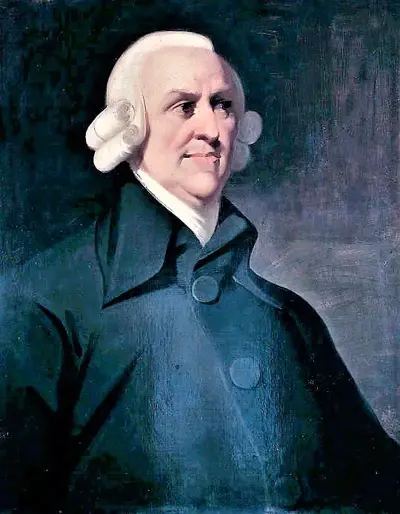
Adam Smith FRSA was a Scottish economist, philosopher as well as a moral philosopher, a pioneer of political economy, and a key figure during the Scottish Enlightenment, also known as ''The Father of Economics'' or ''The Father of Capitalism''. Smith wrote two classic works, The Theory of Moral Sentiments (1759) and An Inquiry into the Nature and Causes of the Wealth of Nations (1776). The latter, often abbreviated as The Wealth of Nations, is considered his magnum opus and the first modern work of economics. In his work, Adam Smith introduced his theory of absolute advantage.
