Albert Einstein Quotes
It is not enough for a handful of experts to attempt the solution of a problem, to solve it and then to apply it. The restriction of knowledge to an elite group destroys the spirit of society and leads to its intellectual impoverishment.
Albert Einstein, 1879-1955, Nobel Laureate in Physics
Sourced by: Eigen's Political and Historical Quotations


The Bush presidency was the most secret presidency in history up to its time with less information available to the public than other administrations in modern times.

The Green Party and The Socialist Party had combined in an alliance. This was their publication. In addition to showing that the right to know and freedom of information was a major issue in other industrial democracies as well as the United States, the quotation is particularly interesting because the title of the article was used over 200 years before by none other than the American patriot, Patrick Henry. See {60328}. The phrase has been used many times in many lands since.


While many people hold that view today, in the 17th century this was truly a radical notion. There were NO democracies at the time and this philosopher argued that the citizens had a need to know that might supersede the need for the state to maintain secrets from enemies. Spinoza was one of the most feared intellectuals in human history-feared that is by the established power structures. He is the only known person who was excommunicated by the Catholics, the Jews and the Muslims-all were forbidden to read his works. He was the enemy of authority and advocated personal reason as the guide for men.
_0_thumbnail_47x47.jpg "Statue of Robert Hall in Leicester.")
For many people the implication of this quotation is that there should be no government secrets withheld from the citizens who have the right to examine. Others argue that government may have temporary secrets to protect against foreign enemies for example, but that these must be declassified very promptly so that the citizens can examine the actions of their government in time to replace the government if they are not satisfied. Almost all government officials tend to reject the first implication out of hand, and grudgingly accept the second with their discretion controlling when declassification should take place. The problem of America is twofold. There is much over-classification (material kept secret that should not be at all), and the time till declassification is long in general and truly absurd in many cases. For example, there are documents from WWII that by 2013 had still not been declassified. See {591444}, {641317}, and {589105} for exemplar views. William Jennings Bryan introduced this principle into the American political dialogue. See {641027}.


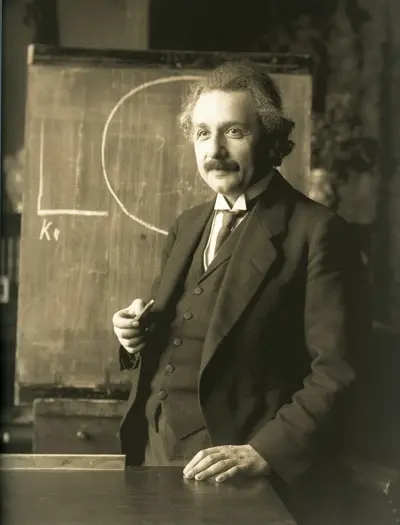
Albert Einstein was a German-born theoretical physicist, widely acknowledged to be one of the greatest physicists of all time. Einstein is known for developing the theory of relativity, but he also made important contributions to the development of the theory of quantum mechanics. Relativity and quantum mechanics are together the two pillars of modern physics. His mass–energy equivalence formula E = mc2, which arises from relativity theory, has been dubbed "the world's most famous equation". His work is also known for its influence on the philosophy of science. He received the 1921 Nobel Prize in Physics "for his services to theoretical physics, and especially for his discovery of the law of the photoelectric effect", a pivotal step in the development of quantum theory. His intellectual achievements and originality resulted in "Einstein" becoming synonymous with "genius".
