William Henry Harrison Quotes
A decent and manly examination of the acts of Government should be not only tolerated but encouraged.
William Henry Harrison, 1773-1841, 9th President of the United States (Whig, OH), Inaugural Address, March 4, 1841
Sourced by: Eigen's Political and Historical Quotations


Coolidge had no involvement in politics after his Presidency. He was never consulted by his successor and never resented that fact.


_0_thumbnail_47x47.jpg "Statue of Robert Hall in Leicester.")
For many people the implication of this quotation is that there should be no government secrets withheld from the citizens who have the right to examine. Others argue that government may have temporary secrets to protect against foreign enemies for example, but that these must be declassified very promptly so that the citizens can examine the actions of their government in time to replace the government if they are not satisfied. Almost all government officials tend to reject the first implication out of hand, and grudgingly accept the second with their discretion controlling when declassification should take place. The problem of America is twofold. There is much over-classification (material kept secret that should not be at all), and the time till declassification is long in general and truly absurd in many cases. For example, there are documents from WWII that by 2013 had still not been declassified. See {591444}, {641317}, and {589105} for exemplar views. William Jennings Bryan introduced this principle into the American political dialogue. See {641027}.


The Bush presidency was the most secret presidency in history up to its time with less information available to the public than other administrations in modern times.


The Green Party and The Socialist Party had combined in an alliance. This was their publication. In addition to showing that the right to know and freedom of information was a major issue in other industrial democracies as well as the United States, the quotation is particularly interesting because the title of the article was used over 200 years before by none other than the American patriot, Patrick Henry. See {60328}. The phrase has been used many times in many lands since.


Marcus Porcius Cato


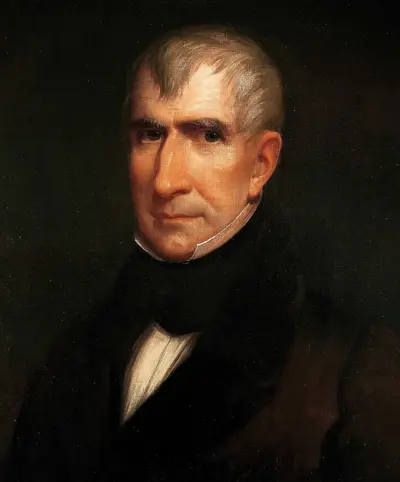
William Henry Harrison was an American military officer and politician who served as the ninth president of the United States for 31 days in 1841, becoming the first president to die in office and the shortest-serving U.S. president in history. His death sparked a brief constitutional crisis regarding succession to the presidency.
