Victor Hugo Quotes
It is in the name of Moses that Bellarmin thunderstrikes Galileo; and this great vulgarizer of the great seeker Copernicus, Galileo, the old man of truth, the magian of the heavens, was reduced to repeating on his knees word for word after the inquisitor this formula of shame: "Corde sincera et fide non ficta abjuro maledico et detestor supradictos errores et hereses." Falsehood put an ass's hood on science.
Hugo, Victor. William Shakespeare. Translated by Melville B. Anderson, A.C. McClurg and Company, 1887, p. 280.


In 1877 Wasburn was dropped from the List of Ministers by the Unitarian Church. He had become very critical of organized and orthodox religion of all kinds. He felt that literal interpretations of the Bible harmed religions as it made a mockery of God to claim His truths were the anachronistic and demonstrable falsehoods of the Book of Genesis. Today most Christians and Jews do not take the Old Testament Literally and in this sense Washburn was one of the early religious reformers of America. There is still a significant number of fundamentalist Christians and orthodox Jews who still believe in the literal truth of everything in the Bible.


Vanderbuilt University was then under the Control of the Tennessee Methodist Episcopal Church and Bishop McTyeire served as the University President. Winchell had written that man had been on earth long before that dates that hade been officially proscribed to Adam and Eve by most church theologians, The university asked for the Professor’s resignation, and when he refused (See {612831}), he was fired. There was no such thing as Academic Freedom at Vanderbuilt at the time. But this case spurred its adoption throughout the country.


Servetus’ book On the Motion of the Heart and Blood of Animals, was so threatening that of the 1000 copies that were printed only 3 survived the burning including ironically Calvin’s personal marked up copy.


Note that Da Vinci predated Galileo. One big difference was that Da Vinci did not publish his heretical views, but wrote them in his private notebook. The church authorities likely did not know about his heresy.


The most contentious issues regarding this Constitutional principle is the attempted prohibition of the teaching of evolution in public schools and/or the requirement to teach “creation science”, a contrary view about evolution which is religious and not science. Evolution is particularly contentious because most religions differ widely on the subject. Amongst Jews, Muslims and Christians, evolution is opposed by most strict fundamentalists and endorsed by the rest—the majority. Except for Roman Catholics where all, even the fundamentalists, accept the Theory of Evolution.

First Astronomy, then Geology, proved that the Creation that was described in the Bible was not literally correct. To religious fundamentalists who believe that every word of the Bible is the word of God or the word of those inspired by God, the only possibility of conclusion is that the science is wrong. To the extent that undermining the word of God is not acceptable to the fundamentalists, they have used every power—including the criminal law power of the state to stop the blasphemy and discredit the scientist. In 1856, there was a much larger proportion of fundamentalists in the Western World than there is today. By 2012, the vast majority of these same populations have rejected Christian Biblical Fundamentalism, and no longer attack science for its affect on religion. The minority of fundamentalists, however, are vehement in their opposition to science.


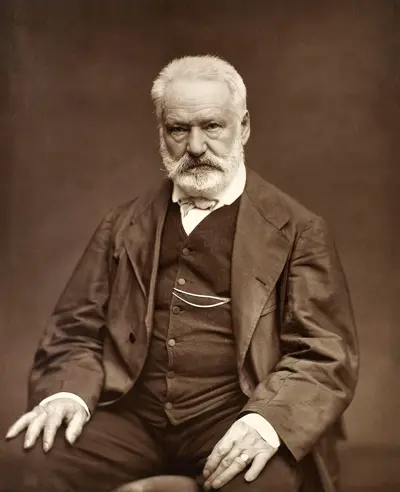
Victor-Marie Hugo was a French poet, novelist, and dramatist of the Romantic movement. During a literary career that spanned more than sixty years, he wrote abundantly in an exceptional variety of genres: lyrics, satires, epics, philosophical poems, epigrams, novels, history, critical essays, political speeches, funeral orations, diaries, letters public and private, as well as dramas in verse and prose.
