Pindar Quotes
It is God that accomplishes all term to hopes, God, who overtakes the flying eagle, outpasses the dolphin in the sea; who bends under his strength the man with thoughts too high.
Pindar. The Odes of Pindar. Translated by Richmond Lattimore, University of Chicago Press, 1947, p. 51.


This sura is interpreted by some Islamic fundamentalists as absolution for the killing of a non-Muslim by a Muslim. It was Allah who did it. In a greater sense, critics of Islam observe that many Muslims and Islamic nations have a double standard of responsibility for crimes. If the victims are Muslims, the normal standards of morality hold; but if a non-believer there can be no crime. Terrorism, torture, beheading, mass murder can all be done with a clean conscience if a Muslim takes this interpretation of this sura. Many Muslims however take an opposite point of view. These people do not have the concept of fatalism and lack of free will that others believe. There is a parallel to this problem in Judeo Christian countries although it is less common statistically. But the murder of physicians who perform abortions, and the Jewish radical fundamentalist who killed innocent Arabs at worship are examples of people who viewed themselves as instruments of God in their heinous activities.

Referring to Woodrow Wilson and his 14 points he insisted upon for the World War I peace treaty.

This quotation is noteworthy because although there are some scientists who are sympathetic to the religious fundamentalist view of the origin of the universe, they are almost always second class scientists. In this case, the scientist is a first class scientist, a Nobel Prize winner in Chemistry. So his quotation has more weight than of most others and is used more often by many fundamentalists who support the Biblical Genesis version of creation rather than the Big Bang scientific explanations and evolution. There are however many great scientists who also are people of faith in a God. They may be religious, but like most religious Americans, interpret the Bible metaphorically and symbolically rather than literally as the fundamentalists do.


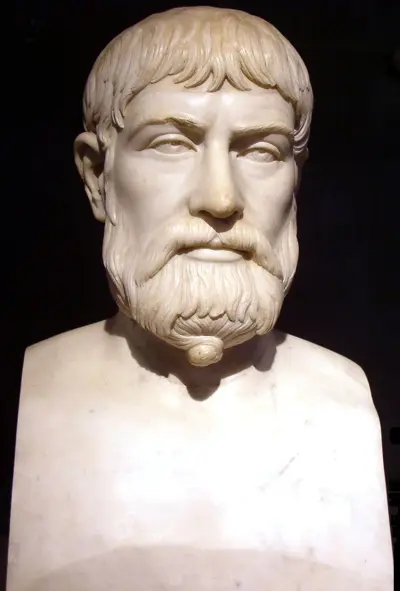
Pindar (/ˈpɪndər/; Greek: Πίνδαρος Pindaros, [píndaros]; Latin: Pindarus; c. 518 – 438 BC) was an Ancient Greek lyric poet from Thebes. Of the canonical nine lyric poets of ancient Greece, his work is the best preserved. Quintilian wrote, "Of the nine lyric poets, Pindar is by far the greatest, in virtue of his inspired magnificence, the beauty of his thoughts and figures, the rich exuberance of his language and matter, and his rolling flood of eloquence, characteristics which, as Horace rightly held, make him inimitable." His poems can also, however, seem difficult and even peculiar. The Athenian comic playwright Eupolis once remarked that they "are already reduced to silence by the disinclination of the multitude for elegant learning". Some scholars in the modern age also found his poetry perplexing, at least until the 1896 discovery of some poems by his rival Bacchylides; comparisons of their work showed that many of Pindar's idiosyncrasies are typical of archaic genres rather than of only the poet himself. His poetry, while admired by critics, still challenges the casual reader and his work is largely unread among the general public.
