Albert Einstein Quotes
It is easier to denature plutonium than to denature the evil spirit of man.
Einstein, Albert. The Ultimate Quotable Einstein. Edited by Alice Calaprice, Princeton University Press, 2010, p. 268.


Fermi was the scientist who organized and planned the first controlled nuclear chain reaction as a part of the Manhattan Project and was one of the major scientific advisors to the Atomic Energy Commission until he, Oppenheimer, and several other scientists opposed the development of the Super (the name Edward Teller had given to the proposed hydrogen bomb). The scientists knew that we had and could make enough atomic bombs to destroy any nation and to make it doable with just a few bombs as opposed to many they saw as of little military
value. They further expected that the Russians and some others would be forced to keep up with us in an arms race and that the bomb would never be able to be used without retaliation in kind and the destruction of most of America. The politicians and military did not really believe that the Russians had the scientific capability to develop hydrogen weapons and some thought if we had them and no one else did, we could dictate a “pax Americana” to the world. Others feared that Russia or some other country would develop a hydrogen weapon and then dictate to us. We did have a monopoly on the Super for a few years and America never dictated to the rest of the world. When other countries developed the weapons, we entered the era of Mutually Assured Destruction (MAD).


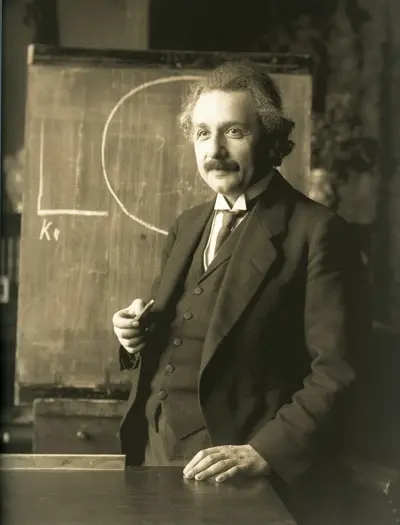
Albert Einstein was a German-born theoretical physicist, widely acknowledged to be one of the greatest physicists of all time. Einstein is known for developing the theory of relativity, but he also made important contributions to the development of the theory of quantum mechanics. Relativity and quantum mechanics are together the two pillars of modern physics. His mass–energy equivalence formula E = mc2, which arises from relativity theory, has been dubbed "the world's most famous equation". His work is also known for its influence on the philosophy of science. He received the 1921 Nobel Prize in Physics "for his services to theoretical physics, and especially for his discovery of the law of the photoelectric effect", a pivotal step in the development of quantum theory. His intellectual achievements and originality resulted in "Einstein" becoming synonymous with "genius".
