Antonin Scalia Quotes
It has never been the case, that if you capture an enemy combatant in war, you have to give him a Jury trial.
The problem that was facing the nation in the early 21st century was when we captured a terrorist, was he a combatant or was he accused by a personal enemy, and had he been tortured to say he was a terrorist. The issue grew more complicated when terrorist suspects were brought to American territory at Guantanamo Bay, and the Courts have always held that a foreigner on American soil had a right to have access to the Federal Courts just as Citizens do. Complicating the situation more was the fact that a few American citizens had joined the terrorists and were they entitled to a civilian trial as all other Americans were.
Antonin Scalia, 1937-2016, U. S. Supreme Court Justice, Quoted on his obituary, CNN, February 13, 2016
Sourced by: Eigen's Political and Historical Quotations


There has always been some confusion in the case of the Wars in Afghanistan and Iraq. The Geneva and Hague conventions are very clear when prisoners are official members of an state’s armed force with uniforms, insignia and ranks. It is also clear with respect to civilians. But the combatants of the insurgent and terrorist forces fall in between, and international law is less clear. The George W. Bush administration at first took the position that the captured combatants were not captured soldiers and were therefore not entitled to the treatment due that status. But the military regulations made no distinction as to how prisoners in combat should be treated. It is a very gray area, except that in either case, torture is illegal under U. S. and under International law.


The Justice Department and the White House were arguing that the Geneva Conventions did not apply to terrorist groups. See {589865}.

Chelsea Elizabeth Manning


When the Union army began using Blacks as recruits, the South threatened to execute any Negro soldier they captured. Some Southerners opposed execution but favored enslavement of captured Northern Black soldiers. The Lincoln threat seems to have worked, although Lincoln opposed executing Southern officers in retaliation for the atrocities at southern prisoner of war camps

Goldsmith headed the Justice Department Office of Legal Counsel—the office that makes legal opinions to guide the Federal Government’s conduct. Goldstein had been asked to render an opinion as to whether terrorists captured in the Iraq War were protected by the Geneva Conventions. The Justice Department staff had concluded that all Iraq civilians were covered including terrorists and insurgents. He was called to meeting at the White House with the President’s and Vice President’s counsels. When Goldsmith revealed the Justice Department conclusion, Addington grew agitated and made this response. The quotation provides insight into the operations of the George W. Bush White House and its relationship with the rest of the government.

Adolf Eichmann was a German Nazi war criminal who had been responsible for the murder of millions of people. At the end of WWII, he had escaped Germany and was living in South America. Israeli agents found him, kidnapped him, and brought him to Israel. There he received a very public trial, was found guilt, and executed. In the War on Terror at the beginning of the 21st century, the key terrorists that were captured in Afghanistan were sent to a special prison base in the American part of Cuba. They were held there but at first received no trials or hearings. They were not prisoners of war, and not criminals where there were legal procedures for handling them. This was a new area. Some argued that they should all get trials. The Supreme court ruled that they at least had to get hearings. The correct handling was a major debate.


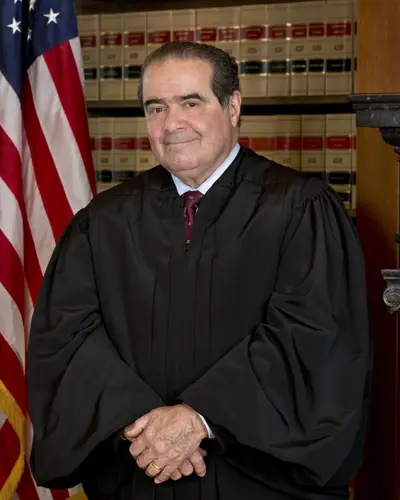
Antonin Gregory Scalia was an American jurist who served as an associate justice of the Supreme Court of the United States from 1986 until his death in 2016. He was described as the intellectual anchor for the originalist and textualist position in the Court's conservative wing. For catalyzing an originalist and textualist movement in American law, he has been described as one of the most influential jurists of the twentieth century, and one of the most important justices in the Supreme Court's history. Scalia was posthumously awarded the Presidential Medal of Freedom in 2018 by President Donald Trump, and the Antonin Scalia Law School at George Mason University was named in his honor.
