Charles Lyell Quotes
It has long been a fact familiar to geologists, that, both on the east and west coasts of the central part of Scotland, there are lines of raised beaches, containing marine shells of the same species as those now inhabiting the neighbouring sea.
Lyell, Charles. The Geological Evidences of the Antiquity of Man. John Murray, 1863, p. 24.


Normal warnings about the upcoming hurricane failed to induce some New Jersey citizens to vacate the New Jersey ocean beaches. There were some who wanted to try and surf in the large storm waves. The Governor did not mince words.

First Astronomy, then Geology, proved that the Creation that was described in the Bible was not literally correct. To religious fundamentalists who believe that every word of the Bible is the word of God or the word of those inspired by God, the only possibility of conclusion is that the science is wrong. To the extent that undermining the word of God is not acceptable to the fundamentalists, they have used every power—including the criminal law power of the state to stop the blasphemy and discredit the scientist. In 1856, there was a much larger proportion of fundamentalists in the Western World than there is today. By 2012, the vast majority of these same populations have rejected Christian Biblical Fundamentalism, and no longer attack science for its affect on religion. The minority of fundamentalists, however, are vehement in their opposition to science.

This image of reality is a little disconcerting to most people as it represents the kind of world political philosophy wants to avoid. It also gives us a different perspective on marine environmentalism and conservation.


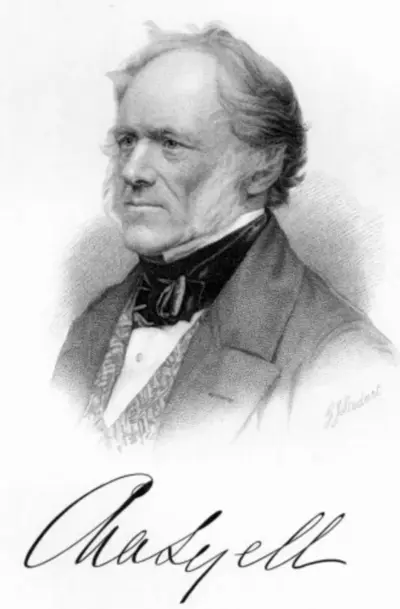
Sir Charles Lyell, 1st Baronet, FRS was a Scottish geologist who demonstrated the power of known natural causes in explaining Earth's history. He is best known as the author of Principles of Geology (1830–33), which presented to a wide public audience the idea that Earth was shaped by the same natural processes still in operation today, operating at similar intensities. The philosopher William Whewell termed this gradualistic view "uniformitarianism" and contrasted it with catastrophism, which had been championed by Georges Cuvier and was better accepted in Europe. The combination of evidence and eloquence in Principles convinced a wide range of readers of the significance of "deep time" for understanding the Earth and environment.
