George H. W. Bush Quotes
International exchanges are not a great tide to sweep away all differences, but they will slowly wear away at the obstacles to peace as surely as water wears away a hard stone.
Bush, George H. W. Public Papers of the Presidents of the United States: George Bush, 1989, Book I. US Government Printing Office, 1990.


In his younger days Jinnah was considered one of the greatest of the Indian Politicians in the Congress Party and all of India. Even though he was a Muslim, his leadership and political philosophy was appreciated by educated and politically active Indians of all faiths and casts. He was also so considered by the English Viceroy and his staff and noted by the politicians in England as a man who could bring Indians together without regard for religious or socio-economic status. He underwent a number of personal tragedies and changed radically until he was not only a sectarian Muslim leader but threatened and facilitated Islamic terrorism against all the other religions. Jinnah's flip flop on this point led to one of the great massacres and tragedies in human history" The Nightingale of India


At the time, Fascist Germany and Japan were aggressively attacking other nations who were trying to mobilize to stop their Fascist ideas of world domination. In America, unlike after WWII, many of the Republican Party Leaders were then isolationists and were adamant that we should not expand our military capability. They wanted to spend no more money on defense. ER and her husband wanted to increase defense spending to increase our military readiness and provide arms to England, China and others who were trying to defend against the Axis. They were castigated as ‘War Mongers’ by the isolationists. ER went to the people to explain that without spending on military strength, there would be no peace. Ironically, the conservative forces who criticized Mrs. Roosevelt as a war monger for building up our military, after WWII when the Cold War began, they criticized her for not being enough of a hawk and not sufficiently supporting the military and aggressive foreign policies.

Actually drafted by Secretary of State, John Foster Dulles

For over 50 years both the United States and Cuba had carried grudges about the Bay of Pigs, the boycott on purcuase of life saving medicine and U. S. attempts to assassiate Fidel Castro on the Cuban site, and the expropriation of Americans' Coban Prepoert, the poor record on human rights, the Mariel Boat Lift, and the harboring of American criminals for the United States. The policy positions held by the two nations had not produced anything constructive so the parties agreed to try and build closer ties. In just two years of a limited reproachment some progress had been made and Prices point about getting beyond the past tried to get all focussed on the future.


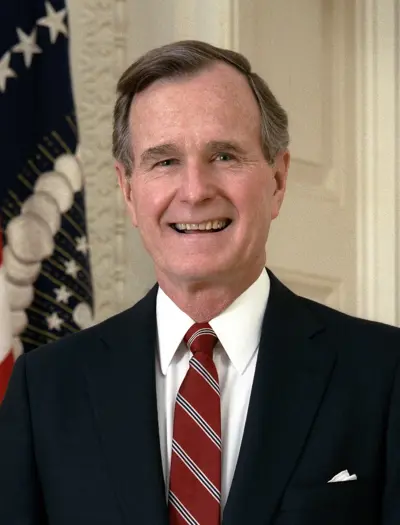
George Herbert Walker Bush was an American politician, diplomat and businessman who served as the 41st president of the United States from 1989 to 1993. A member of the Republican Party, Bush also served as the 43rd vice president from 1981 to 1989 under Ronald Reagan, in the U.S. House of Representatives, as U.S. Ambassador to the United Nations, and as Director of Central Intelligence.
