Chiang Kai-shek Quotes
In the early days of the Russian Revolution in 1917, I was completely in sympathy with it. I felt that it established a new era in the history of the modern world. I was so overwhelmed by it that, if people made any unfriendly comment, I would vigorously defend it. If people condemned the Communist party, I would speak in its defense.
Chiang, Kai-shek. Soviet Russia in China: A Summing-up at Seventy. Farrar, Straus and Cudahy, 1957, p. 13.


The “October Revolution” was the Russian Revolution of 1917.


Lenin, Uritsky, and other Bolshevik leaders were attacked in 1918. Lenin was wounded but Utrtsky died, and this triggered the attacks on the other Russian factions by the Bolsheviks known as the “Red Terror.”


In 1921 an Paul E. De Mott, an American Quaker famine relief worker in Germany was arrested as a "Bolshevik" and murdered without trial. American correspondents heard about the crime and asked for a statement from the chief American diplomat in Germany.

Ransome had a unique access to Post Russian Revolutionary leadership as his fiancée was the secretary to key Russian Communist party committees and through her he had access to Lenin, Trotsky and other leaders. In general Ramsome is best known as a children’s book author.

So many Afghans thought very differently and resisted Amin’s Government and the Russians, that the Russians pulled out of Afghanistan.

Only 6 years after the Russian Revolution Lenin was already being perceived as an international provocateur and instigator of problems.


See the Related Quotation for a good contemporary example of the clerics whop were party tools.


Zenzinov was often a critic of the Bolsheviks.

This quotation illustrates White’s favorable view of Russia. Note his use of the “it works” phrase which he picked up from Stefens’ famous quote {634892}. At the time the Soviet Union had been perceived by many economists to have been a great economic improvement over Czarist Russia. And over all, Russia which in 1917 was an economic basket case, had become one of the stronger states in Europe although the Russian people paid a horrendous price. Most historians agree that White passed classified information to the Russians. He was accused of being a Communist, but there was never any evidence of that. Some people believe that he was a spy for the Russians and committed espionage, but others disagree observing that White was very much his own man and felt that much information that was classified never should have been. White substituted his own judgment, it is believed, about what could be given to the Russians for the security system. He was an admirer of what Russian socialism had accomplished economically, educationally and medically since the 1917 revolution deposing the Czar. Russia had been a valuable military ally, which had taken the brunt of both military and civilian casualties in WWII. White’s economics were certainly not Marxist but very much Keynesian. He was subpoenaed by the House Un-American Activities Committee where he was accused of being a Communist which he denied (see {634907}). He died of a heart attack 3 days later.
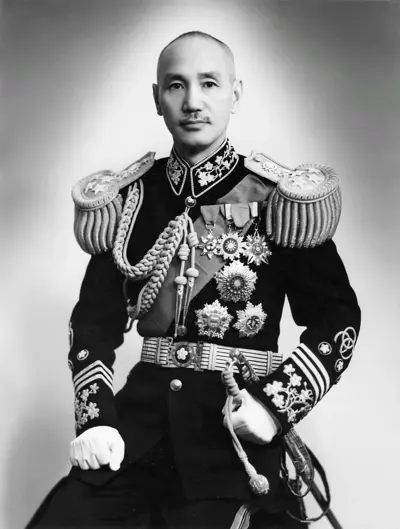
Chiang Kai-shek, also known as Chiang Chung-cheng and romanized via Mandarin as Chiang Chieh-shih and Jiang Jieshi, was a Chinese Nationalist politician, revolutionary and military leader who served as the leader of the Republic of China between 1928 and 1975, first in mainland China until 1949 and then in Taiwan until his death.
