Vladimir Lenin Quotes
Communism is Soviet power plus the electrification of the whole country.
Nikolai Lenin, 1870-1924, Russian Communist Premier, 1920
Sourced by: Eigen's Political and Historical Quotations

So many Afghans thought very differently and resisted Amin’s Government and the Russians, that the Russians pulled out of Afghanistan.

Advocating a revolution against the Karenski provisional government: Vladimir Lenin

This quotation illustrates White’s favorable view of Russia. Note his use of the “it works” phrase which he picked up from Stefens’ famous quote {634892}. At the time the Soviet Union had been perceived by many economists to have been a great economic improvement over Czarist Russia. And over all, Russia which in 1917 was an economic basket case, had become one of the stronger states in Europe although the Russian people paid a horrendous price. Most historians agree that White passed classified information to the Russians. He was accused of being a Communist, but there was never any evidence of that. Some people believe that he was a spy for the Russians and committed espionage, but others disagree observing that White was very much his own man and felt that much information that was classified never should have been. White substituted his own judgment, it is believed, about what could be given to the Russians for the security system. He was an admirer of what Russian socialism had accomplished economically, educationally and medically since the 1917 revolution deposing the Czar. Russia had been a valuable military ally, which had taken the brunt of both military and civilian casualties in WWII. White’s economics were certainly not Marxist but very much Keynesian. He was subpoenaed by the House Un-American Activities Committee where he was accused of being a Communist which he denied (see {634907}). He died of a heart attack 3 days later.

After the 1917 Russian Revolution many of the Western Countries sent troops to Russia where they aided the Whites against the Reds. When the Red Bolsheviks prevailed, there were many attempts to diplomatically and economically undermine the Communist government. This caused a unity among different Russian factions. Sforza urged leaving them alone and letting the Bolsheviks fail by their own ideology. Most Western nations and the United States did not agree with him.


Ataturk was not receptive toward Communism as some other world leaders were at the time. He saw its weakness far earlier than many others.

Lev Davidovich Bronstein. Although Plekhanov was the intellectual giant of Russian communism, he died only two years into the revolution. He was never happy with some of the pragmatic compromises the younger firebrand communist leaders were making from their ideals. By the time he passed away, most, especially the younger, communist leaders like Stalin saw him as an old obstructionist and he was never celebrated as a hero by the communists. It was Trotsky and older leaders like Lenin who appreciated him. See {590463}.


Others proclaimed the republic as well and a power struggle ensued.

Ransome had a unique access to Post Russian Revolutionary leadership as his fiancée was the secretary to key Russian Communist party committees and through her he had access to Lenin, Trotsky and other leaders. In general Ramsome is best known as a children’s book author.


This is an example of what made the Cold War so difficult. The Italian Communists had great misgivings about the Russian version of Communism that tended to abuse human rights and try and control other countries. However, when the Russian Communists were under world attacks by the West, as with their incursion into Hungary, he urged that all the Communists stick together and defend the Russians even for policies that they thought wrong. On the West side, the same thing occurred. The United States tolerated and supported a number of terribly oppressive dictatorships that were virulently anti-Communist. Polarization was the international norm.

The “October Revolution” was the Russian Revolution of 1917.

This was only 6 years after the Russian Revolution. Communist Russia had extended its influence to much of the world without firing a shot. To many, communism looked like the future. The Russian inability to make communism work economically in the next 70 years destroyed most of its influence.

Vladimir Lenin. See {640096} and {640094} for more on the Communist struggle with the Russian Peasants.


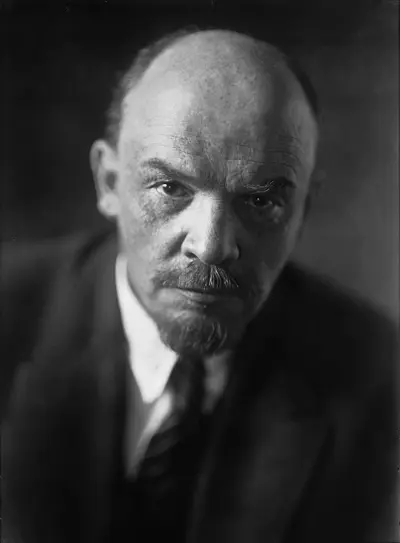
Vladimir Ilyich Ulyanov, better known by his alias Lenin, was a Russian revolutionary, politician, and political theorist. He served as the first and founding head of government of Soviet Russia from 1917 to 1924 and of the Soviet Union from 1922 to 1924. Under his administration, Russia, and later the Soviet Union, became a one-party socialist state governed by the Soviet Communist Party. A Marxist, he developed a variant of this communist ideology known as Leninism.
