Dick Cheney Quotes
In Congress we face the possibility of radical cuts based on nothing save grand compromises over what parochial interests need to be satisfied.
Richard B. Cheney, Vice President of the United States (Republican), U. S. Congressman (Republican, WY), White House Chief of Staff, U. S. Secretary of Defense, Speech, National Newspaper Association, Washington DC, March 17, 1990
Sourced by: Eigen's Political and Historical Quotations

This is a perennial problem whenever the Chief's of Staff want to cut any program. Even if the program is a failure or is no longer needed Congress fights cuts tooth and nail. Then they make speeches decrying government spending and especially waste, when the vast majority of the waste is in programs or operations upon which they have insisted.


Although the Professor was often right about this technique, at the time he made this statement, the Clinton administration was actually cutting spending and using much of the revenue to pay for the deficit—just the opposite of what the Professor was worried about. It was successful and the deficit was eliminated and surpluses were projected. However the succeeding administration more closely followed the professor’s pattern and increased spending enormously for serious needs, but also cut taxes, so that we went during the Bush administration from the largest projected surplus in American history to the greatest deficit in American history.


After the Stock Market crash of 1929, Republican politicians promised "recovery is right around the corner." But La Guardia disagreed:


Attacking opponent Ronald Reagan's campaign promises:. Anderson lost the election. Reagan made good on the last two of the three promises, but ran up the largest deficits in American history.


In 1964 the treasury secretary asked the president how to sell the proposed budget to Congress:


He and Bowles were the two leaders of the Presidential National Commission on Fiscal Responsibility and Reform. The commission recommendations to put the nation on a sound financial footing involved sacrifice by almost every sector of American society—everyone would have to give up something that they valued. So the initial reaction of almost every interest group was to oppose the plan. Over time however, there was a realization that unless the burden would be borne by some and not by others, the plan was reasonably fair. It illustrates the initial reaction of Americans to reform proposals is to retain all the benefits that they have and have others give up their benefits.


Finding some accounting difference relieves the politician of the difficult choice between raising taxes or cutting expenses. That is why it has been so popular. Besides, it is a way of taking todays problem and pushing them off on politicians to come as the accounting gimmicks always have to be paid for at some point. Accounting gimmicks are not just small items. The Republicans, during the George W. Bush administration financed all the costs of Bush’s 2 wars by not counting any of the expenses on the budget and therefore they didn’t have to raise taxes to pay the expenses, which just got added to the national debt to be paid by future administrations.

Roosevelt was very candid with the American people that there would be high cost to war and sacrifice would be needed. See {584569} for other similar candor. This quotation was often used by critics of George W. Bush who initiated the Iraq War and then cut taxes for the rich, but then financed the war through the budgetary emergency appropriations bypassing the budget rules that the revenue must be specified to pay for it. His administration even claimed at an early stage in the war that the oil revenue from Iraq oil would defray the costs.


The Republicans had, in the view of most Americans at the time, refused to pass the legislation to provide money for the government to function unless President Obama would cancel the Health Care Reform that was his major legislative achievement of his first term, and passed over the objections of most Republicans who claimed it was unconstitutional. Then the Supreme Court upheld the Constitutionality of Obamacare, and the Tea Party Republicans pressured the regular republicans to shut down the entire government until the President relented and cancelled his own legislation. The American people resented this unprecedented of interfering with the Constitutional methods by which laws are passed, and after over a week of taxpayer additional costs for less service, the regular Republicans made a deal with the Democrats and produced a majority to reopen the Government.


In the non-defense side of the budget a very large proportion of the budget is for entitlements like Social Security and Mediacre which are obligations that must be paid. The remainder, the smaller part is everything else--funding the cabinet departments, all the medical and sdcientific research, all the federal aid to public dchools and police departments, all the welfare, foodstamp and other programs for the poor, the costs of the Federal COurt System, the White House, the Congress, the State Department, foreign aid, Homeland security, weatehr forcasting, all the agricultural programs, and viirtually everything the governmetn does. In 2017 President Donals Trump submitted a budget to COngress that increased defense spending by a fulll 10 percent, and gave a hugh tax cut for the wealthy and the corporations. To balance the budget, he propsoed eliminateing man of the existing progrms like "Meals on Wheels" which brings at least 1 hot meal a day to homebound poor eldertly people, and a host of other critical programs. He had no previous experience with a government budget which was thoudands of times larger and more complex than any budget he had ever seen. So many in Congress, in both partiesd, were very critical of the budget and Congress then started to create its own buget. This quote expressed the heart of the problem.


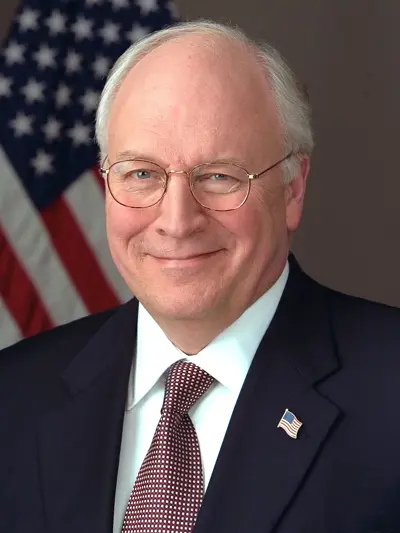
Richard Bruce Cheney is an American politician and businessman who served as the 46th vice president of the United States from 2001 to 2009 under George W. Bush. He has been cited as the most powerful vice president in American history. He is also one of the most unpopular American politicians, holding an approval rating of just 13% upon leaving office. Cheney has been the oldest living former U.S. vice president since 2021, following the death of Walter Mondale.
