Joseph Stiglitz Quotes
In an economy, when the government spends more and invests in the economy, that money circulates, and recirculates again and again. So not only does it create jobs once: the investment creates jobs multiple times.
Stiglitz, Joseph E. Freefall: America, Free Markets, and the Sinking of the World Economy. W. W. Norton & Company, 2010.


Reference to the British Economist John Maynard Keynes who advocated government action to manage the economy.


It is actually true that public works do create indirect jobs, however the efficiency of indirect job creation is not very good. If the government spends $100 on a public works project half might go to construction materials and the rest pays the salary of construction workers. Part of the materials purchase pay the salaries of workers in the supply chain. And most of the salary gets spent on goods and services which helps to pay other workers and thus jobs are created when there is a public works construction project. However the reason FDR did not want this fact to be publicized is because the economic relationships to indirect jobs is counterintuitive. Many people hearing that public works construction also produces jobs say “Well then let us fund many more government public works programs and create even more jobs—keep spending on projects until there is no more unemployment.” However that is not a sustainable strategy. There is enough benefit in the direct jobs and the use of the public improvement, that it was, in FDR’s view, sufficient without “selling” the indirect job creation picture.

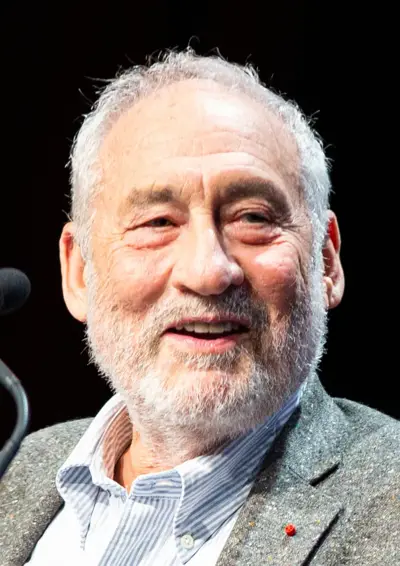
Joseph Eugene Stiglitz is an American economist, public policy analyst, and a professor at Columbia University. He is a recipient of the Nobel Memorial Prize in Economic Sciences (2001) and the John Bates Clark Medal (1979). He is a former senior vice president and chief economist of the World Bank and is a former member and chairman of the (US president's) Council of Economic Advisers. He is known for his support of Georgist public finance theory and for his critical view of the management of globalization, of laissez-faire economists (whom he calls "free-market fundamentalists"), and of international institutions such as the International Monetary Fund and the World Bank.
